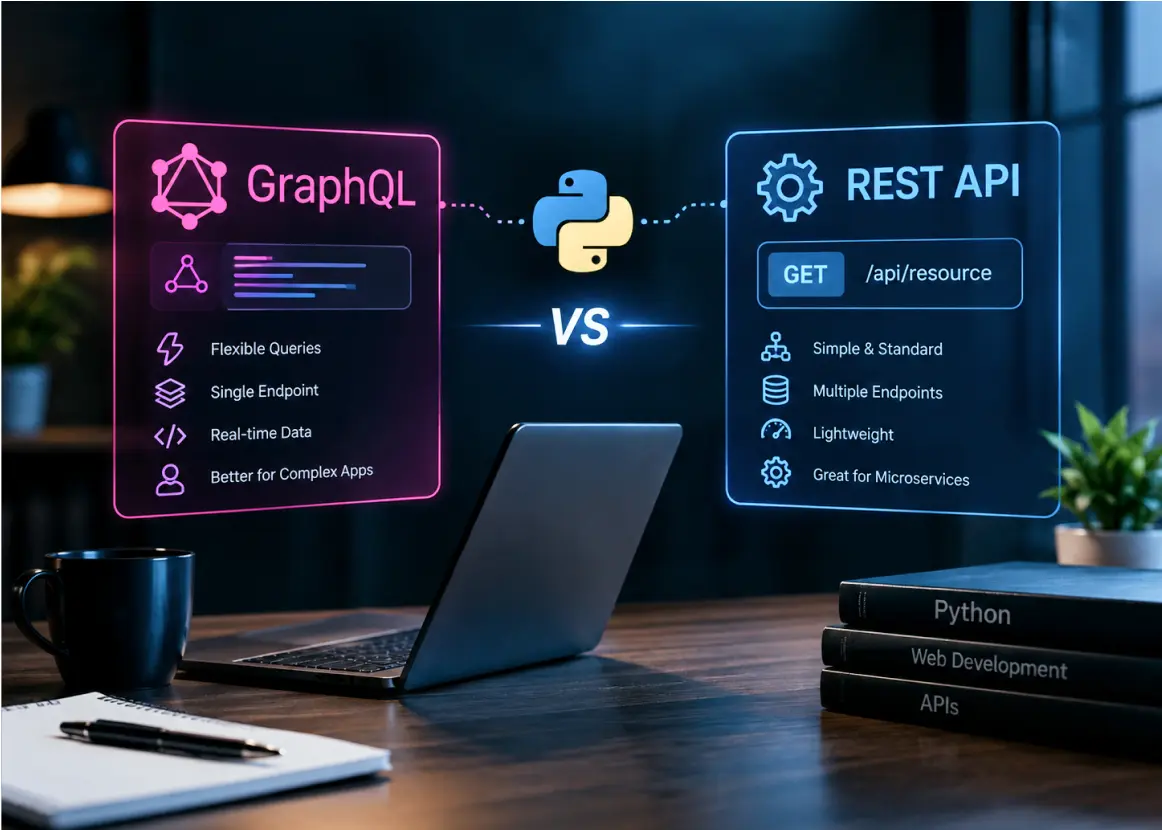
If you're building an application with Python, you need a way for it to exchange information with other applications and services.
REST has been the usual choice for a long time. Most developers know how REST APIs work, and there are plenty of tools for building and maintaining them.
GraphQL is another option.
It gives the application asking for the data more control over what comes back. That can be helpful when you have a website, mobile app, and other applications that all need different information.
So, which one should you use?
There isn't a simple answer. REST may be the better choice for one application, while GraphQL may make more sense for another.
In this guide, we'll look at how both work, where each one fits, and what to keep in mind when you're building a Python application.
GraphQL vs REST API: Key Differences
The basic difference is pretty simple.
With REST, you usually have different URLs for different types of information. You might have one URL for users and another for their orders.
If the application needs both, it may have to make more than one request.
GraphQL works differently. Instead of calling several URLs, the application usually sends its request to one place and tells the server what information it wants.
Here's a simple example.
REST
[ Client ] ---- GET /api/users/42 ------------> [ Users Service ]
[ Client ] <--- 200 OK { id, name, role_id } -- [ Returns User ]
[ Client ] ---- GET /api/roles/12 ------------> [ Roles Service ]
[ Client ] <--- 404 Not Found { error } ------- [ Transport & App Error ]
The application first asks for the user and then makes another request for the user's role.
GraphQL
[ Client ] ---- POST /graphql -----------------> [ GraphQL Engine ]
query {
user(id: 42) {
name
role { title }
}
}
[ Client ] <--- 200 OK { data: ..., errors: [] }
The application can ask for the user and the role at the same time.
That's the main idea behind GraphQL.
What is a REST API?
REST is a common way of building APIs around things such as users, products, orders, and customers.
Each type of information usually has its own URL. The application then uses standard HTTP actions to work with that information.
For example:
- GET gets information.
- POST creates something.
- PUT changes something.
- DELETE removes something.
REST also uses familiar status codes to show what happened. A 200 OK usually means the request worked. A 404 Not Found means the requested item couldn't be found. A 500 usually points to a problem on the server.
One of the biggest reasons REST remains popular is that it's easy to understand. Developers have been working with it for years, and most development teams already have experience with it.
What Is GraphQL?
GraphQL was created at Meta in 2012 and made available to the public in 2015.
The basic idea is that instead of having a separate URL for every type of information, the API usually has one endpoint, such as /graphql.
The application then tells the API exactly what it wants.
For example, a customer page might need a customer's name, email address, and recent orders. With GraphQL, the application can ask for those specific pieces of information instead of receiving a much larger response.
GraphQL also has a defined list of the information and actions that the API supports. This makes it easier for developers to see what they can ask for.
There's one difference that can sometimes surprise developers: GraphQL may return an HTTP 200 OK even when part of a request fails. The actual error information is then included in the response.
REST API vs GraphQL: What's the Difference in Practice?
Both GraphQL and REST API architectures can work well. The better choice depends on the specific requirements of the application you're building.
Here is the complete updated comparison table incorporating the new rows ("Python Frameworks" and "Best Suited For") while keeping the natural keyword density for GraphQL vs REST API intact:
| Feature / Dimension | REST API | GraphQL API |
|---|---|---|
| Python Frameworks | FastAPI, Django REST Framework (DRF) | Strawberry, Ariadne |
| Endpoints & Routing | Multiple resource-based URLs (e.g., /api/v1/users, /api/v1/orders) | Usually one endpoint (typically /graphql) |
| Data Fetching | Endpoint-defined; the REST API server decides the fixed payload structure | Client-defined; the client sends a GraphQL query asking for exact fields |
| Over/Under-Fetching | Common issue; endpoints often return extra unneeded data or require multiple calls | Can reduce over-fetching and under-fetching by allowing clients to request the fields they need |
| Error Handling | Uses standard HTTP status codes (200 OK, 404 Not Found, 500 Server Error) | Returns HTTP 200 OK header by default; error details are inside an errors JSON array |
| Live Updates & Streaming | Usually requires adding WebSockets or Server-Sent Events (SSE) to the REST API | Supports native event-driven GraphQL subscriptions over WebSockets out of the box |
| Data Structure & Schema | Optional schema definition; often documented using tools like OpenAPI or Swagger | Uses a strictly defined, strongly typed GraphQL schema (SDL) as a single source of truth |
| Caching Dynamics | Works seamlessly out-of-the-box with standard HTTP caching, reverse proxies, and CDNs | Requires application-level caching (e.g., Redis) or client-side normalized caches (Apollo) |
| Versioning & Evolution | Requires explicit URI or header versioning (e.g., /v1/, /v2/) | Versionless schema evolution; fields are added or marked with @deprecated over time |
| Best Suited For | CRUD applications, public APIs, file uploads, and simple microservices | Complex relational data, mobile apps, and multi-client environments |
Again, neither one is automatically the better choice.
GraphQL vs REST API for Python: Which Is Better?
Choosing GraphQL vs REST API for Python depends on how you plan to use Python backend with your frameworks, databases and/or client devices. There is extensive tool support available in the Python environment for both patterns, each with its own set of architectural benefits:
- With FastAPI + REST or Django REST Framework (DRF), you get instant access to CRUD and standardized Python decorators and built-in API documentation through Swagger. On the other hand, libraries such as Strawberry GraphQL and Ariadne have been designed for Python and use Python's native syntax (type hints and dataclasses) to automatically generate strongly typed schema definitions.
- Async Python Applications: REST and modern Python GraphQL applications are natively supported for asynchronous execution (async/await). Whether you are routing multiple REST endpoints, or running multiple concurrent GraphQL field resolvers, Async Python performs well.
- ORM Interaction is one of the factors to take into account when comparing GraphQL vs REST API for Python. Standard REST endpoints allow for easy optimization of SQL. While building a dynamic query in GraphQL, you can easily end up with the N+1 database problem in your Python ORM (SQLAlchemy or Django ORM) without the help of some batching tools like aiodataloader and Strawberry's DataLoader.
- FastAPI + REST endpoints work seamlessly with HTTP proxies and edge CDNs, making it easy to pull off Caching & Microservices. But when you have multiple internal microservices to support different fontends (like web dashboards, iOS apps and Android apps), a single GraphQL API gateway makes it easy to fetch data from your clients as a single network call.
Why Use GraphQL over a REST API?
GraphQL became popular because it solves a few common problems developers run into with REST.
1. You Can Ask for Only What You Need
Sometimes a REST endpoint sends back a lot of information when the application only needs a few fields.
The opposite can happen, too. The application may not get everything it needs, so it has to make another request.
GraphQL lets the application ask for the specific fields it needs.
For mobile apps, this can be useful because there may be less information traveling over the network.
2. You Can Get Related Information Together
Let's say you're building a customer page.
The page needs the customer's details, their orders, and information about those orders.
With REST, you may need several requests to get all of that information.
With GraphQL, you can ask for the related information in one query.
That can make things simpler for applications that work with a lot of connected data.
3. Different Apps Can Ask for Different Information
Your website may need more information than your mobile app.
For example, your website might show a customer's full profile, while the mobile app only needs the customer's name and profile picture.
With REST, you may end up creating or changing endpoints to support those different needs.
With GraphQL, both applications can use the same API and ask for different fields.
4. It Can Support Live Updates
GraphQL subscriptions can be used when information needs to be updated without the user refreshing the page.
This can be useful for things such as chat, notifications, and live dashboards.
It's not the only way to build these features, but it's an option when an application needs information to update in real time.
Building REST APIs With Python
Python has several good options for building REST APIs.
Two common choices are FastAPI and Django REST Framework (DRF).
FastAPI
FastAPI is often used for newer Python API projects. It supports asynchronous code, checks incoming data, and can automatically create API documentation.
Django REST Framework
Django REST Framework is a popular choice for teams already using Django. It gives developers the tools they need to turn Django applications into APIs.
Example: FastAPI REST API
Here's a simple FastAPI example:
from fastapi import FastAPI, HTTPException
from pydantic import BaseModel
app = FastAPI(title="User Service REST API")
class UserResponse(BaseModel):
id: int
name: str
email: str
role: str
USERS = {
1: {
"id": 1,
"name": "Sarah Connor",
"email": "sarah@example.com",
"role": "Admin"
}
}
@app.get("/api/v1/users/{user_id}", response_model=UserResponse)
async def get_user(user_id: int):
user = USERS.get(user_id)
if not user:
raise HTTPException(
status_code=404,
detail="User not found"
)
return user
In this example, the application asks for a user by ID.
If the user exists, the API returns the user's information. If the user isn't found, it returns a 404 error.
Building GraphQL APIs With Python
You can build GraphQL APIs with Python, too.
Two libraries you may want to look at are Strawberry GraphQL and Ariadne.
Strawberry GraphQL
Strawberry uses Python's type hints and dataclasses to define the information available through the API. It can be used with FastAPI and Django.
Ariadne
Ariadne is another Python option for building GraphQL APIs. It uses a different approach for defining the API's schema and works with asynchronous applications.
Example: Strawberry GraphQL With FastAPI
Here's a basic example:
import strawberry
from fastapi import FastAPI
from strawberry.fastapi import GraphQLRouter
from typing import Optional
@strawberry.type
class User:
id: int
name: str
email: str
role: str
@strawberry.type
class Query:
@strawberry.field
async def user(self, id: int) -> Optional[User]:
if id == 1:
return User(
id=1,
name="Sarah Connor",
email="sarah@example.com",
role="Admin"
)
return None
schema = strawberry.Schema(query=Query)
graphql_app = GraphQLRouter(schema)
app = FastAPI()
app.include_router(graphql_app, prefix="/graphql")
The example is small, but it shows the basic idea. The API defines what information is available, and the application can ask for the fields it needs.
Things to Watch Out for With GraphQL
GraphQL has some clear benefits, but it isn't perfect.
There are a few things developers need to plan for before using it.
1. Too Many Database Queries
Here's a common example.
Suppose your application asks for 50 orders and the customer information for each order.
If the code isn't set up properly, the application might make one database request to get the orders and then another request for every customer.
That means 51 database requests.
As the application grows, this can slow things down.
How to Fix It
DataLoaders can group these requests together so the application doesn't have to make a separate database request for every customer.
Python libraries such as aiodataloader and Strawberry's DataLoader can help with this.
2. Very Large or Complicated Requests
GraphQL gives the person making the request a lot of freedom.
That's useful, but it also means someone could send a request asking for a huge amount of connected information.
For example:
user → friends → friends → friends → friends...
If there are no limits in place, a request like this could put a lot of pressure on the server.
This matters even more for APIs that are available to outside users.
How to Handle It
You can set limits on how deep or complicated a request can be.
If a request goes beyond those limits, the server can reject it instead of trying to process it.
3. Caching Isn't as Simple
Caching is one area where REST has an advantage.
With REST, different resources usually have different URLs. That makes it easier for standard web caching systems and CDNs to store responses.
GraphQL usually sends different requests to the same /graphql endpoint, so caching those requests takes a little more work.
How to Handle It
You can use something such as Redis to store frequently requested information.
Client-side caching can help too. Apollo Client, for example, provides tools for managing cached GraphQL data.
When Should You Use GraphQL vs REST API for Python Applications?
Don't choose one just because it's newer or more popular.
Think about what your application actually needs.
REST May Make More Sense When:
- You're building an API for partners or outside developers. REST is familiar to most developers, which can make integrations easier.
- You're working with lots of files or media. REST can be a straightforward option for file uploads and similar workloads.
- Caching is a major part of your application. REST works well with standard web caching and CDNs.
- Your application is relatively simple. If you're mostly creating, reading, updating, and deleting information, REST may be all you need.
GraphQL May Make More Sense When:
- You have several applications using the same data. Your website, iOS app, and Android app may all need different information.
- Your data comes from several places. GraphQL can give applications one way to ask for information that lives across different services.
- You want to avoid sending unnecessary data. This can be helpful for mobile applications and users with slower connections.
How Kellton Can Help You Choose GraphQL or REST API in Python?
Choosing REST or GraphQL doesn't have to be an all-or-nothing decision.
Some organizations use both.
For example, REST can be used for certain internal services while GraphQL is used to give web and mobile applications a simpler way to get the information they need.
The right setup depends on your existing systems, your applications, and what you're planning to build.
At Kellton, we help organizations build and improve Python APIs.
Our work includes:
- API Design and Modernization: Help move older applications toward REST or GraphQL-based services.
- GraphQL Federation: Bring information from multiple services together through one GraphQL API.
- Performance and Security: Find and fix problems such as unnecessary database requests and put limits in place for overly complicated GraphQL queries.
Conclusion
So, which is better: GraphQL or REST?
Neither one wins in every situation.
REST is still a great option when you want something simple, familiar, and easy to integrate with other systems. It's especially useful when you have straightforward services or rely heavily on standard web caching.
GraphQL can be a better fit when different applications need different information or when your data is spread across several services.
Both work well with Python.
The important thing is to choose based on what your application actually needs. You don't need to use GraphQL just because it's newer, and you don't need to stick with REST just because your team has used it before.
If you're building a new Python application or trying to improve an existing API, talk to Kellton's software engineering team about your options.
Want to explore how GraphQL Federation could work with your Python services?
Frequently Asked Questions
Q1. What's the difference between GraphQL and REST API?
Ans. There are two major differences between GraphQL and REST API architecture: GraphQL offers a single endpoint that returns a flexible payload whereas REST offers multiple endpoint URLs that return the same fixed payload.
Q2. What is the advantage of GraphQL over REST API in Python?
Ans. Neither is the best in all situations; you'll need to weigh the pros and cons of each solution when deciding between GraphQL and REST API on Python for your project.
Q3. Rest or GraphQL API? FastAPI REST or GraphQL in Python?
Ans. The comparison between GraphQL and REST API for Python performance highlights that FastAPI REST suits well for simple microservices and extensive caching while FastAPI with GraphQL is well-suited for dynamic, multi-client application performance.
Q4. Is it possible to use FastAPI with GraphQL?
Ans. Yes, FastAPI has a GraphQLRouter that easily integrates with GraphQL libraries such as Strawberry, so in the context of implementing GraphQL and REST API for Python, you can effortlessly implement both patterns.
Q5. But is GraphQL faster than REST API?
Ans. A comparison of GraphQL vs REST APIs highlights the ability of GraphQL to be faster on slow mobile connections due to smaller payloads and fewer round trip requests, but an under-invested REST API can sometimes be faster than an under-invested GraphQL API.
Q6. What are the pros and cons of using GraphQL over REST API?
Ans. Among the advantages of using GraphQL instead of REST API, let's highlight the ones that you won't want to miss: you avoid over-fetching or under-fetching data; you receive nested resources in one request; you benefit from a strongly typed schema.
Q7. At what point is it ok to use REST API vs GraphQL?
Ans. If your application extensively uses CDN caching, supports standard third-party developer integrations, or has to deal with large file uploads, you should select REST API over GraphQL.
Q8. Is it possible to use GraphQL and REST in Python apps?
Ans. Yes, many engineering teams deploy REST microservices internally when they choose to implement GraphQL vs REST API for Python architectures, and use a federated GraphQL gateway at the edge for web or mobile clients.
Ready to streamline your Python backend?
Talk with Kellton’s engineering team to design an API strategy that fits your platform.