
Most enterprise AI budgets are being spent on the wrong model because teams default to the largest frontier model for every task, including those that clearly don't need it, such as classifying support tickets, extracting fields from invoices, routing requests, or validating structured outputs. The result is a predictable pattern of inflated inference costs, unpredictable latency, and infrastructure that becomes harder to control the more it scales.
The fix isn't smaller models replacing large ones, since that framing misses the actual shift underway: specialization, where the best-architected AI products stop asking which model is the smartest and start asking which small language model can complete this task reliably, then route accordingly.
In this blog, we explore what small language models are, how they differ from large language models (LLMs) where they fit in agentic AI frameworks, which enterprise workloads they suit, and how engineering teams should design production architectures around them. The key takeaways about small language models include:
- What is a small language model? An SLM is a relatively compact language model designed to deliver useful language, reasoning, or task-specific capabilities with lower compute and memory requirements. There is no universal parameter threshold.
- Why are SLMs growing? Better training, fine-tuning, quantization, and specialized architectures are making smaller models viable for more production workloads.
- Can SLMs support agentic AI? Yes. They are increasingly suited to bounded tasks such as routing, extraction, function calling, validation, and repetitive tool execution.
- Will SLMs replace LLMs? No. Enterprises should combine models and route workloads based on complexity, risk, latency, privacy, and cost.
- What is the strategic opportunity? Build a model portfolio rather than designing an entire product around one large model.
A small language model is not defined by one universally accepted parameter count. The more useful definition is architectural: an SLM is a language model small enough to operate with materially lower memory, compute, latency, or infrastructure requirements than frontier-scale models while still meeting the requirements of a specific workload.
That distinction matters because the term is increasingly applied to models with very different sizes and capabilities. Microsoft, for example, positions several Phi models as small language models, including Phi-4, which has 14 billion parameters. Its Phi-4 reasoning work also demonstrates that model size alone does not determine reasoning capability. Microsoft reports that specialized training and inference-time reasoning techniques can substantially improve the performance of comparatively smaller models on complex tasks.
The practical question for an enterprise is therefore not: “How many parameters does this model have?”
It is: “Can this model perform the required task at the required level of accuracy, reliability, latency, and cost?”
That shift changes how AI architecture should be designed.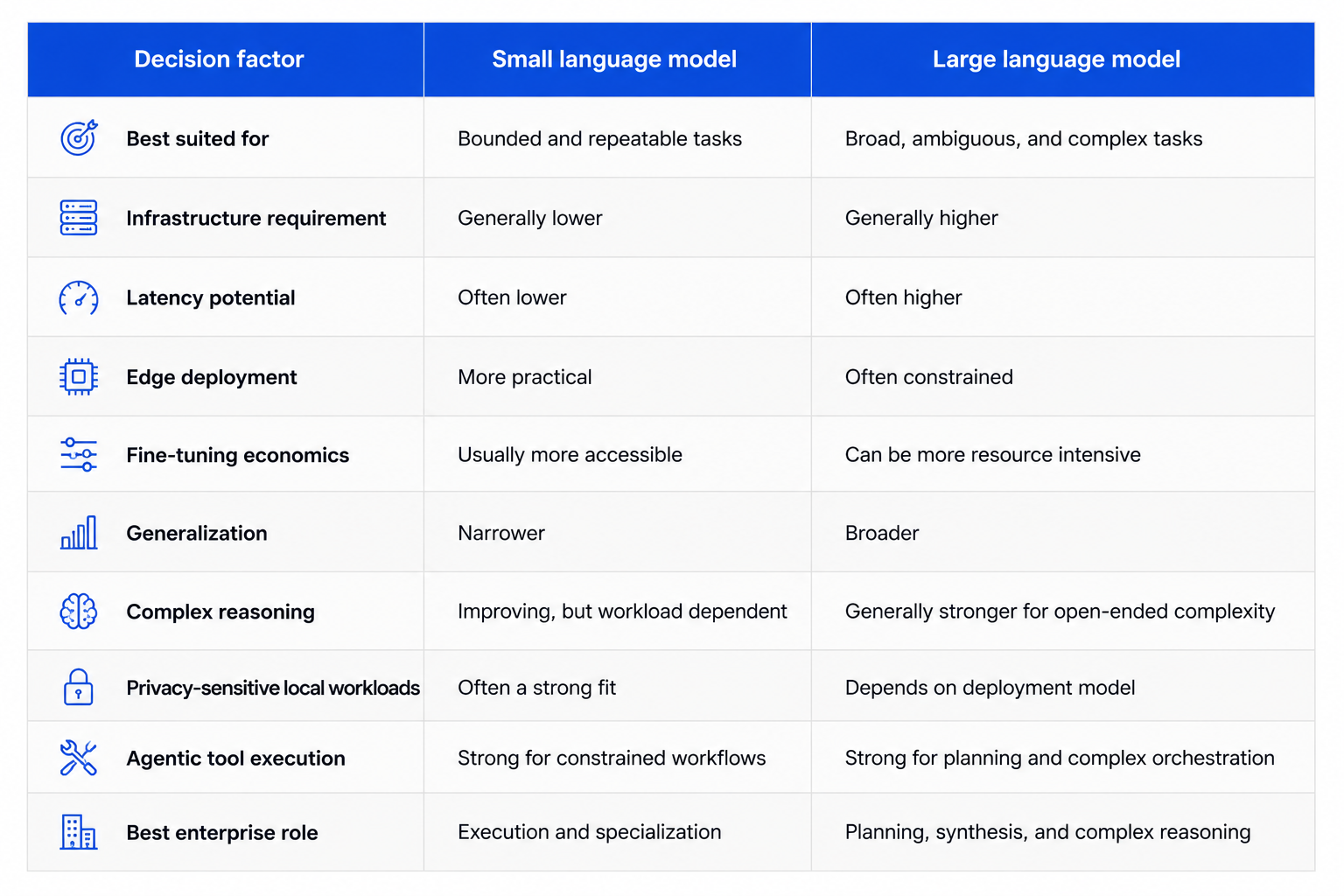
The distinction should not be treated as a capability hierarchy. A larger model is not automatically the better production choice. It may simply be a more expensive solution to a problem that could have been handled by a specialized model.
Google's FunctionGemma provides a useful illustration. It is based on the Gemma 3 270M architecture and is specifically trained to improve function calling. The point is not that a 270-million-parameter model can replace a frontier model. The point is that a narrowly defined task can benefit more from specialization than from general-purpose scale.
Why are small language models becoming important in 2026?
The rise of small language models is being driven by an engineering problem rather than by a simple preference for smaller AI, since enterprise AI workloads are expanding in volume and complexity in ways that make the old approach hard to sustain. A single AI assistant may now perform multiple model calls for one user interaction, and an agent handling a single request might need to classify the intent, retrieve relevant context, choose the right tool, validate an output, execute an action, and generate a final response, all within the span of one exchange.
Using a high capability general purpose model for every one of those operations is difficult to justify, both economically and architecturally, when most of those steps are narrow, repetitive, and well within the reach of a much smaller model. This is why many now see small language models as central to the future of agentic AI, since the bulk of agentic workloads consist of specialized, repetitive subtasks that can be handled more economically and often just as reliably by smaller models built or tuned for that narrow purpose.
That said, it remains important to recognize that heterogeneous systems using multiple models together are still the right approach whenever genuine general purpose conversational or reasoning capability is required, since no small model can substitute for broad reasoning across unfamiliar or ambiguous situations. The more established pattern already emerging is a complementary architecture, where lightweight models absorb straightforward or latency sensitive requests while larger models are reserved for the smaller share of requests that actually demand deeper reasoning.
The strategic implication of this shift is significant, because it suggests that the AI architecture of the future may end up being defined less by which single model an enterprise chooses to standardize on and more by how intelligently that enterprise routes each task to the model best suited to handle it.
The main forces accelerating SLM adoption
- Lower infrastructure requirements: Smaller models can make local, edge, or dedicated deployment more practical. This matters where latency, connectivity, data boundaries, or infrastructure control are important.
- Task specialization: A model trained or fine-tuned for a narrow workload may outperform a general-purpose model on that workload despite having fewer parameters.
- Agentic AI economics: Agent architectures can multiply the number of model invocations. Optimizing individual calls can therefore have an outsized impact on total operating cost.
- On-device intelligence: Small models are increasingly being designed for constrained environments. Microsoft's Phi family has been optimized for deployment across multiple hardware environments, including mobile and web scenarios. Microsoft has also introduced Phi variants specifically designed for compute-constrained and low-latency environments.
- Data control: For some workloads, keeping inference closer to the application or enterprise environment can simplify data handling and reduce dependence on external inference services. This does not eliminate governance requirements, but it expands deployment options.
How do small language models compare with large language models in enterprise applications?
The common comparison between SLMs and LLMs is too simplistic because it focuses almost entirely on model capability.
Enterprise architecture requires a broader view.
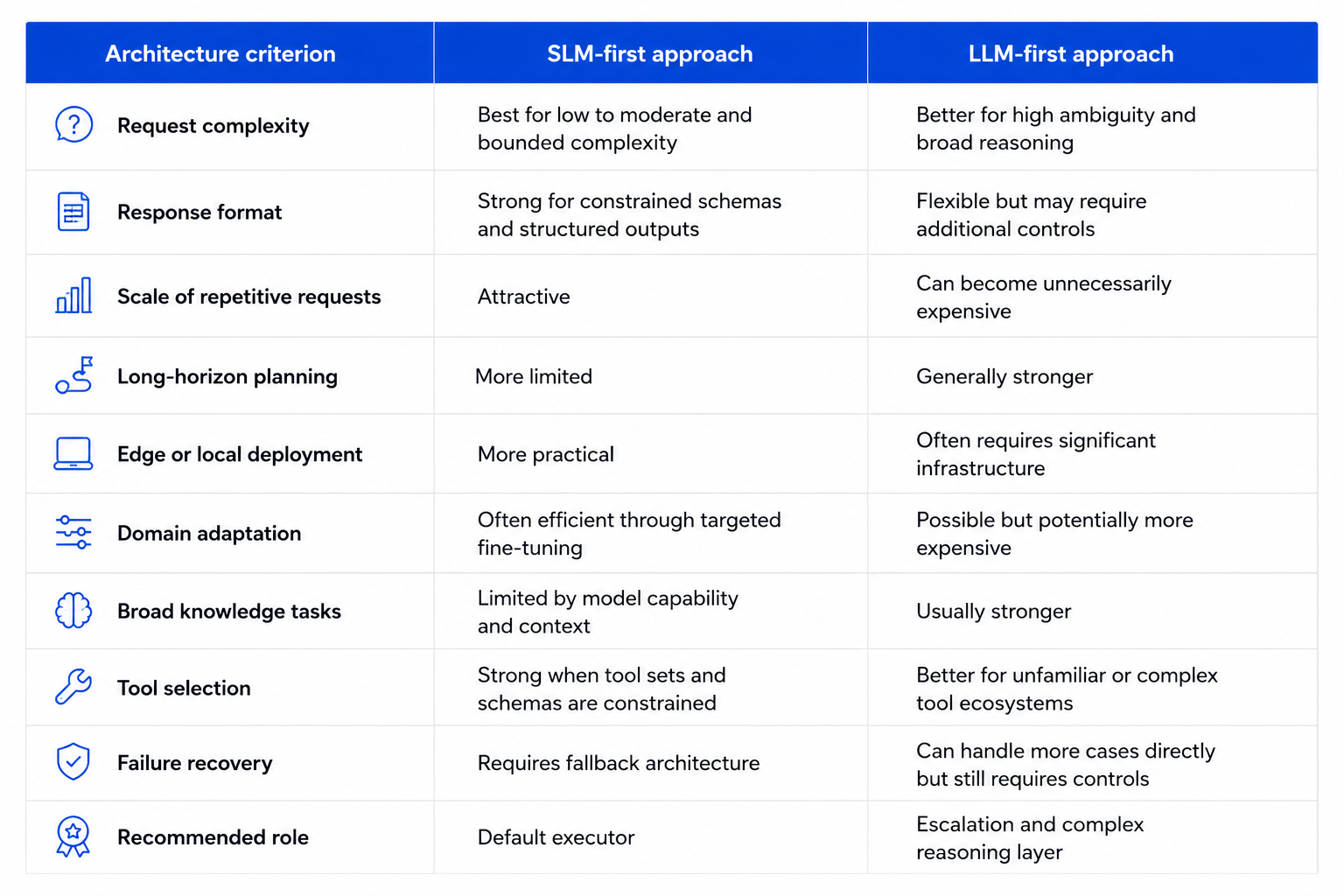
The key trade-off is not small versus powerful. It is specialized efficiency versus general capability. A production system should be explicitly designed around that trade-off.
When should an enterprise use a small language model?
The decision to use a small language model should not be driven by cost alone, since the more useful question an enterprise needs to answer first is what kind of problem it is actually trying to solve, because the workloads best suited to smaller models tend to share a specific shape, one that is bounded, repetitive, measurable, and high volume, rather than open ended or exploratory. A useful way to work through this is to evaluate the task against five questions, each of which reflects a lesson that teams running production AI systems have learned the hard way.
The first question is whether the task is bounded, meaning the model has a relatively narrow and well defined job rather than an open ended one, since tasks like extracting fields from documents, categorizing support requests, classifying security events, converting unstructured text into structured data, or selecting from a fixed set of tools all share a common trait, which is that the space of acceptable outputs is small even if the volume of inputs is large. Many teams that have moved these kinds of tasks off frontier models report that the model was never the bottleneck to begin with, since a narrow task rarely benefits from broader reasoning capacity it never needed in the first place.
The second question is whether the output itself is constrained, since small models tend to perform best precisely in situations where the result can be checked against something external, whether that is a schema, a policy, or a deterministic rule, because this turns model output from an open ended judgment call into something closer to a pass or fail check, and that verification step is often what allows a smaller, less capable model to be trusted in production even when it occasionally makes mistakes a larger model would not.
The third question is whether the workload is high volume, since the economics of model selection shift substantially once a task is being executed thousands or millions of times a day rather than occasionally, and this is where the cost gap between a large general purpose model and a smaller specialized one stops being a rounding error and starts becoming a meaningful line item, one that compounds further once latency and infrastructure overhead are factored in alongside raw inference cost.
The fourth question is whether latency matters to the experience being built, since applications that depend on near real time interaction, or that need to run on constrained devices without a reliable connection to a large remote model, tend to run into hard physical limits with larger models regardless of how well resourced the enterprise is, which makes smaller, faster models less of a preference and more of a requirement in these contexts.
The fifth and often most overlooked question is whether success can actually be measured, since a task should ideally come with clear evaluation criteria that define what a correct answer looks like, and this turns out to matter more than model size in practice, because teams that cannot clearly define correctness for a given task tend to struggle with model selection at any scale, not just when choosing between large and small models, which suggests that the real prerequisite for using a small language model well is not a smaller model at all, but a clearer definition of the problem it is being asked to solve.
When should enterprises avoid using a small language model?
The small language model narrative becomes misleading the moment efficiency is treated as a substitute for capability rather than as a complement to it, since a smaller model can be fast, cheap, and reliable within its lane while still being the wrong choice entirely once a task steps outside that lane. Small models should never be forced into workloads that exceed their reasoning, knowledge, planning, or context handling limits simply because they worked well on a different, narrower task, since capability does not transfer evenly across problem types just because the underlying architecture is efficient.
An enterprise should be especially cautious when a task involves any of the following:
- Open ended strategic analysis, where there is no single correct answer to converge on
- Complex multi step planning, where errors early in the chain compound into failures later on
- High ambiguity, where the model has to make judgment calls rather than follow clear rules
- Novel problem solving, where the task has no close precedent the model can pattern match against
Large and changing knowledge domains, where information goes stale faster than a smaller model can be retrained or fine tuned - Difficult long context synthesis, where the model has to hold and reconcile many threads of information at once
High consequence decisions made without strong independent verification - Tasks where failure is genuinely difficult to detect automatically, since this removes the safety net that makes smaller models trustworthy elsewhere
There is growing evidence that smaller models can make real progress on complex reasoning tasks when they are purpose built and carefully trained for it, and that progress is worth taking seriously, but it does not establish that every small model is suitable for every reasoning workload, since capability remains specific to each model and should be evaluated against the actual task at hand rather than assumed from general trends in the field.
This is why the correct architecture is often not a choice between a small model and a large one at all, but rather the design of a controlled path between them, one where a task can start with a smaller model and escalate automatically to a larger one the moment it exceeds what the smaller model can reliably handle, so that efficiency and capability stop competing with each other and start working as parts of the same system.
How can small and large language models work together?
The strongest enterprise architecture is increasingly not a single model at all but a model portfolio, one where different models are deliberately assigned different jobs based on what each is actually good at, rather than one model being stretched to cover every task simply because it was the first one integrated into the system.
User or enterprise system
|
v
Request assessment layer
|
+-------+--------+
| |
v v
Bounded task Complex task
| |
v v
Small model Large model
| |
+-------+--------+
|
v
Validation and policy layer
|
v
Enterprise systems and tools
The routing decision itself can weigh several factors at once, including task complexity, required response time, data sensitivity, required accuracy, tool availability, context size, estimated cost, confidence score, and overall business risk, since no single factor is sufficient on its own to determine which model should handle a given request.
This pattern tends to produce a far more resilient architecture than embedding a single model provider or a single model size into every workflow, since resilience in this context comes less from any one model being powerful and more from the system's ability to route around the limitations of whichever model is handling a given step. Complementary architectures built around this idea are already emerging across the industry, with smaller models increasingly used as a filter or triage layer that handles the bulk of incoming requests before anything complex enough to warrant it gets escalated to a larger model further down the chain.
A practical version of this routing pattern often looks something like the following.
Incoming request
|
v
Can deterministic logic solve it?
|
Yes | No
|
v
Deterministic service
|
v
Is the task bounded?
|
Yes / \ No
/ \
v v
SLM LLM
|
v
Confidence and validation
|
+----+-----+
| |
Pass Fail
| |
v v
Execute Escalate
This kind of thinking should extend well beyond model routing alone, since a genuinely production ready enterprise architecture also depends on identity and access controls, retrieval and context management, tool permissions, output validation, observability across the full pipeline, evaluation processes that run continuously rather than once at launch, clearly defined fallback policies for when something goes wrong, and human approval built in wherever the consequences of an error are too high to leave fully automated.
The model, in the end, is only one component of the system, and treating it as the whole system is often where these architectures start to break down.
Why could small language models become the execution layer of agentic AI?
Agentic AI fundamentally changes the economics of model selection in a way that a simple chatbot never had to confront, since a traditional chatbot might generate one or two model calls for a single interaction, while an agentic system can quietly perform many more operations behind the scenes before it ever produces a visible response.
A single agent workflow, broken into its real steps
Consider what a procurement agent actually has to do to handle one request from start to finish. It has to classify the user's intent, look up the relevant policy, retrieve the right documents, extract supplier data from those documents, select the appropriate tool for the job, execute that tool via an API, validate the result it returns, and only then generate a response the user actually sees.
Not every one of these steps requires the same level of capability, since the planning stage or any point where genuine ambiguous reasoning is required may well justify a larger model, while intent classification, extraction, tool selection, and validation often do not, because each of those steps is narrow enough that a smaller, more specialized model can handle it just as reliably and at a fraction of the cost.
The case for an SLM-first approach
This is the central argument behind treating small language models as the default rather than the exception in agentic systems. It is gaining traction in current research on agentic AI architecture, much of which argues that specialized tasks repeated at scale are particularly well suited to smaller models and proposes heterogeneous systems in which larger models remain available as a fallback whenever broader reasoning capability is genuinely required.
More recent work on agentic system design tends to reinforce this idea, favoring architectures in which small models handle requests by default and escalate to larger models only when needed, particularly for workloads that prioritize structured accuracy, reliable function calling, low latency, and cost control. It is worth being clear, though, that this remains an emerging direction in the field rather than settled enterprise doctrine, and enterprises adopting it should treat it as a promising pattern to test rather than a proven standard to simply implement.
What this means for enterprise architecture?
The most important optimization available to an enterprise may not be making a single model smarter, but rather reducing the number of times an expensive model needs to be called at all, and this reframing creates three concrete engineering priorities worth building around.
- The first is to specialize agent tasks by breaking large, monolithic agent workflows into smaller, individually measurable operations, since a workflow that cannot be broken down cannot be optimized with any precision.
- The second is to route intelligently, using a larger model only when a smaller model or a deterministic system genuinely cannot complete the task safely on its own, rather than defaulting to the larger model out of caution or convenience.
- The third is to validate before escalating, since a schema validator, a policy engine, or a deterministic service can often catch an error far more cheaply and more reliably than asking another large model to review the first model's output.
What does a production architecture for small language models look like?
A small language model sitting directly behind a chat interface is not, on its own, an enterprise AI architecture, and treating it as one is where many early implementations run into trouble. A genuine production system needs several distinct layers working together rather than a single model absorbing every responsibility.
The layers a real system needs start at the top, where an application layer provides whatever surface the user actually interacts with—whether that is a web app, a mobile app, an internal tool, or a broader enterprise application, built with an experienced AI mobile app development company. Beneath that sits an orchestration and routing layer whose job is to assess each incoming request against factors such as complexity, risk, latency, cost, and data sensitivity, and to decide where that request should go within the broader agentic AI framework.
From there, requests are split between small models that handle classification, extraction, and tool calling, and larger models that handle planning, deeper reasoning, and synthesis, depending on what the routing layer determines each request needs. Beneath that sits a validation and control layer, which checks outputs against schemas, policy engines, guardrails, and confidence thresholds before anything is allowed to proceed further.
Beneath that sits the enterprise's own intelligence layer, comprising retrieval systems, vector search, internal APIs, databases, and event streams, all of which give the models something grounded to work with rather than relying on parametric knowledge alone. Finally, running underneath all of it, an observability and evaluation layer continuously tracks quality, latency, cost, drift, failures, and security across the entire system rather than at any single point.
+----------------------------------------------------------+
| Application layer |
| Web | Mobile | Internal tools | Enterprise applications |
+---------------------------+------------------------------+
|
v
+----------------------------------------------------------+
| AI orchestration and routing layer |
| Complexity | Risk | Latency | Cost | Data sensitivity |
+------------------+------------------+--------------------+
| |
v v
+---------------+ +---------------+
| Small models | | Large models |
| Classification| | Planning |
| Extraction | | Reasoning |
| Tool calling | | Synthesis |
+---------------+ +---------------+
| |
+---------+--------+
|
v
+----------------------------------------------------------+
| Validation and control layer |
| JSON schema | Policy engine | Guardrails | Confidence |
+----------------------------------------------------------+
|
v
+----------------------------------------------------------+
| Enterprise intelligence |
| RAG | Vector search | APIs | Databases | Event streams |
+----------------------------------------------------------+
|
v
+----------------------------------------------------------+
| Observability and evaluation |
| Quality | Latency | Cost | Drift | Failures | Security |
+----------------------------------------------------------+
This layered structure points to a critical design principle that is easy to state but frequently ignored in practice: a language model should never be asked to enforce rules that software can already enforce deterministically.
- If an output has to conform to a schema, that should be validated directly rather than hoped for.
- If an action requires authorization, that authorization should be enforced outside the model entirely.
- If a transaction carries real financial or operational consequences, it should require a deterministic check rather than depending on a model to get it right through reasoning alone.
Holding to this principle is often what reduces the pressure to reach for a larger, more expensive model simply to compensate for weak system design elsewhere in the pipeline, and it is frequently the difference between an architecture that scales cleanly and one that quietly accumulates cost as it grows.
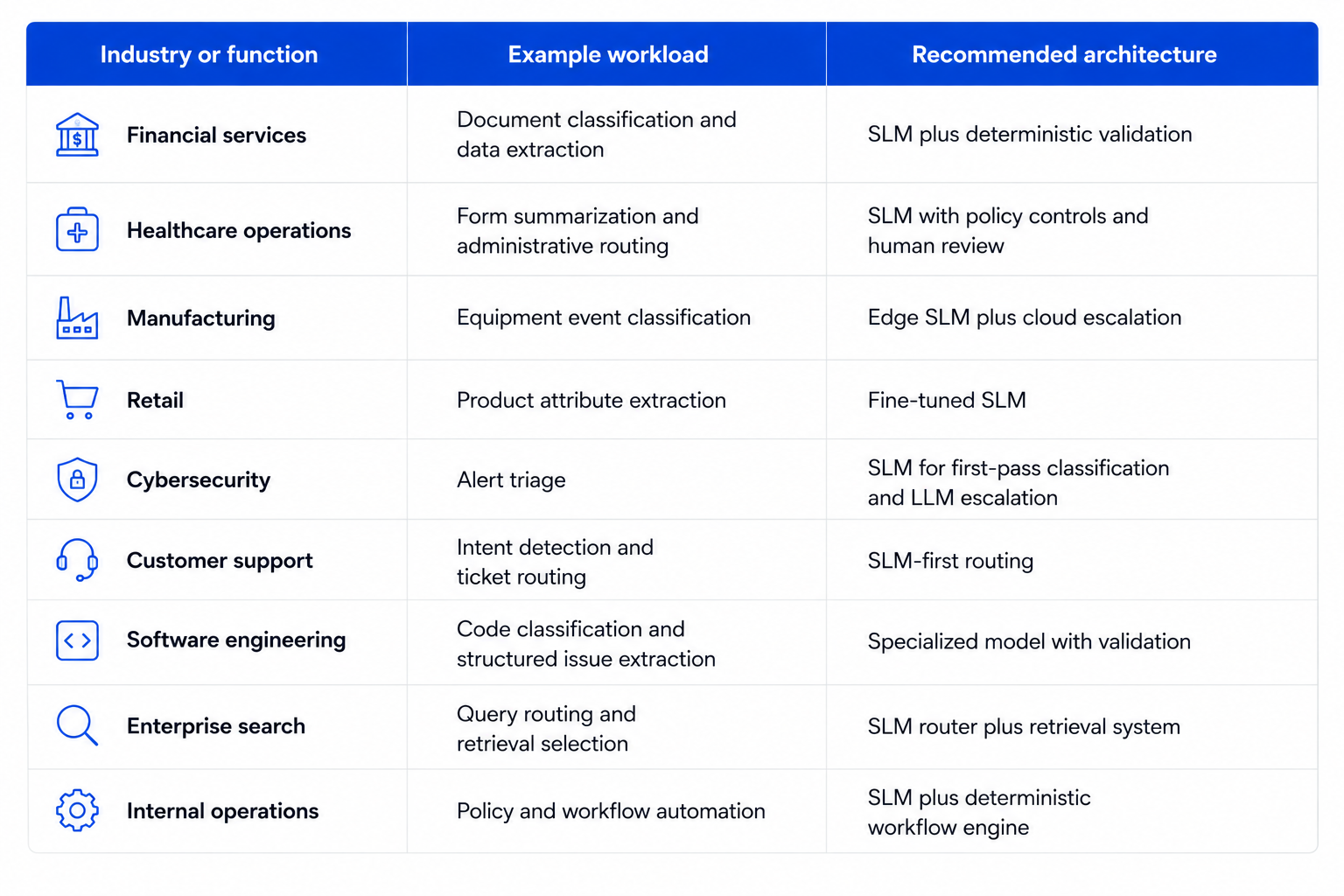
Which enterprise use cases are best suited to small language models?
The strongest use cases share one characteristic: the task can be defined clearly enough to measure success.
How should engineering teams evaluate a small language model before production deployment?
Benchmark scores are a reasonable starting point for narrowing down candidates, but they should never be treated as the basis for an actual deployment decision, since a model that performs well on a general benchmark is not the same thing as a model that performs well on the specific workload it will actually be asked to handle in production. The only evaluation that really matters is one run against the real task, using real inputs, under conditions that resemble how the model will actually be used.
A practical evaluation framework should measure at least five distinct dimensions, each of which tends to reveal problems the others miss.
- Task quality
The first and most fundamental question is whether the model actually completes the business task correctly, not in a general sense but against the specific inputs and edge cases that task involves in production, since a model can score well on a broad benchmark while still failing consistently on the particular patterns that show up in a company's real data.
- Structured output reliability
Because most production tasks depend on the model producing usable, machine readable output rather than free-form text, teams need to measure how reliably the model generates valid output against the expected schema, how accurate individual fields are once extracted, and how often parsing fails outright, since even a small failure rate at this stage can cascade into much larger problems further down an automated pipeline.
- Operational performance
Beyond correctness, teams need to measure how the model actually behaves under real operating conditions, including typical and worst case latency, overall throughput, memory usage, and how often the system fails or times out, since a model that performs well in isolated testing can behave very differently once it is handling real, concurrent production traffic.
- Economic efficiency
Cost needs to be measured in relation to total infrastructure and inference spend against successful task completion, not evaluated as an abstract number on its own, since the true cost of running a model only becomes clear once it is weighed against how reliably that model actually gets the job done.
- Safety and governance
Finally, teams need to test how the model behaves under adversarial or unexpected conditions, including susceptibility to prompt injection, risk of data leakage, likelihood of selecting the wrong tool or an unauthorized one, tendency toward policy violations, and overall failure behavior when something does go wrong, since a model that performs well under normal conditions can still pose serious risk if it fails in unpredictable or unsafe ways under pressure.
- The metric that actually matters
A genuinely useful enterprise metric is not simply cost per token, since that number says nothing about whether the model is actually accomplishing what it was deployed to do. The metric that matters is cost per successful task, because a cheap model that fails repeatedly and has to be retried, corrected, or escalated can end up costing significantly more in practice than a larger, more expensive model that gets the task right on the first attempt.
Expert recommendation: Build the evaluation set before choosing the production model. If the evaluation criteria are defined after the model has been selected, teams often optimize around the model's strengths rather than the business requirement.
What are the biggest implementation mistakes with small language models?
Most failures attributed to small language models turn out, on closer inspection, to be architecture failures rather than genuine model failures, since the model is often doing exactly what it was capable of doing while the system around it was never designed to catch or compensate for its limitations.
| Mistake | Why it fails | Better approach |
|---|---|---|
| Choosing by parameter count | Size does not predict workload success | Evaluate against production tasks |
| Replacing every large model with a small one | Some tasks require broader reasoning | Use escalation and routing |
| Ignoring output validation | Smaller models can still hallucinate or misformat outputs | Use schemas and deterministic checks |
| Deploying without observability | Quality degradation becomes invisible | Track task, cost, latency, and drift |
| Using generic benchmarks only | Benchmarks may not represent enterprise data | Build workload specific evaluation |
| Overusing prompt engineering | Prompts cannot solve every capability gap | Fine-tune, redesign, or escalate |
| Giving models excessive tool access | Errors become operational risks | Apply least privilege tool permissions |
| Treating local deployment as automatically secure | Security depends on the entire architecture | Apply full identity, data, and device controls |
The most serious mistake by far is designing an application around the quiet assumption that the model will always behave correctly, since no model, regardless of size, behaves correctly every time, and production systems need to be built with that assumption in mind rather than discovering it the hard way after launch. A well designed system assumes failure as a normal part of its operation and defines clearly what should happen next when it occurs.
How should enterprises optimize small language models for production?
Optimization should always begin with the workload itself rather than with the model, since tuning a model in isolation, without reference to how it will actually be used, tends to produce improvements that look good in testing but fail to translate into real gains once deployed.
Optimization should always begin with the workload itself rather than with the model, since tuning a model in isolation, without reference to how it will actually be used, tends to produce improvements that look good in testing but fail to translate into real gains once deployed.
- Use constrained outputs
Wherever possible, responses should be required to follow a structured format and validated directly against a defined schema, since this turns an open ended generation task into something that can be checked automatically rather than trusted on faith.
- Fine-tune for repeatable domain tasks
Fine-tuning tends to be worthwhile specifically when a workload is stable, repeated frequently, and difficult to address reliably through prompting alone, since these are the conditions under which the upfront investment in fine-tuning is most likely to pay off over time.
- Use retrieval selectively
Retrieval augmented generation is not something every workload automatically requires, but when a task depends on knowledge that changes frequently or is proprietary to the enterprise, retrieval can supply that context directly rather than requiring the model to have memorized it internally, which keeps the model smaller while keeping its answers current.
- Use constrained outputs
Wherever possible, responses should be required to follow a structured format and validated directly against a defined schema, since this turns an open ended generation task into something that can be checked automatically rather than trusted on faith.
- Quantize after measuring quality
Quantization can meaningfully reduce memory and inference requirements, but its effect on output quality needs to be measured directly after the fact rather than simply assumed to be negligible, since that assumption is often where quiet quality regressions slip into production unnoticed.
- Cache predictable work
Many requests, including repeated queries, embeddings, classifications, and retrieval results, do not need to trigger a full model execution every time, and caching them when the underlying input has not meaningfully changed can substantially reduce both cost and latency.
- Build explicit fallback paths
Every production system should define, in advance, when a task should escalate to a larger model, when it should instead be handed off to a deterministic workflow, when it needs to be routed to a human reviewer, and when the right response is simply a retry with additional context, since leaving these decisions undefined tends to mean they get made inconsistently, if at all, in the moment something actually goes wrong.
- Observe the system, not just the model
Meaningful observability means monitoring the input distribution reaching the model, overall task success, latency, cost, how often requests are escalated, tool failures, and policy violations, since watching the model's output alone misses most of what actually determines whether a production system is healthy.
The broader direction across the industry reinforces this same pattern, with newer small-model releases increasingly optimized for specific capabilities and infrastructure constraints, rather than any single enterprise converging on a universal model architecture.
How will small language models evolve beyond 2026?
The most credible outlook for where small language models are headed is not that they will eventually become universally capable as large frontier models aim to be, but rather that specialization will become a more important design variable across AI systems generally, regardless of how capable any individual model becomes.
Small models continue to gain ground in reasoning, multimodal understanding, and deployment flexibility, with recent releases across the field including reasoning-focused, multimodal, and compact variants, each designed around different sets of constraints and workloads rather than a single general-purpose design. Alongside this, increasingly specialized models are being developed for narrow functions, such as function calling, reflecting a broader move toward models built for a job rather than general capability.
Enterprises are increasingly gaining access to large, growing model catalogs rather than converging on a single universal model, with a widening range of proprietary and open models now available across various marketplaces and platforms. This trend only increase the importance of model selection, governance, and intelligent routing going forward, since choice without a disciplined way to navigate it tends to create complexity rather than reduce it.
How can Kellton help enterprises build AI products with small language models?
Small language models create a product engineering opportunity that goes beyond AI experimentation. The challenge is to determine which workloads should use smaller models, which require larger models, and how those models should interact with enterprise software, data, APIs, and users.
Kellton helps enterprises turn this complexity into a working advantage, designing model portfolios, routing logic, and validation layers around real business requirements rather than trends. From evaluation frameworks to production architecture, Kellton builds AI systems engineered for reliability, cost efficiency, and long-term scalability.
Frequently asked questions about small language models
Q1. What is a small language model?
A small language model is a relatively compact AI model designed to perform language or reasoning tasks with lower compute and memory requirements. There is no universally accepted parameter threshold. Suitability depends on the workload, deployment constraints, and required performance.
Q2. What is the difference between a small language model and a large language model?
SLMs generally require fewer computational resources and are better suited to bounded, specialized, or latency-sensitive tasks. LLMs generally provide broader knowledge and stronger performance on complex, ambiguous, or open-ended tasks.
Q3. Are small language models better than large language models?
Neither is universally better. SLMs can be more efficient for narrow and repetitive workloads, while LLMs are generally better suited to broader reasoning and complex tasks. The right choice depends on the application.
Q4. Are small language models the future of agentic AI?
SLMs are likely to become important for repetitive and bounded agent tasks such as routing, extraction, and tool execution. Larger models will continue to play a role in complex planning, reasoning, and ambiguous decision-making. Hybrid architectures are likely to be more practical.
Q5. Can small language models run on devices?
Yes. Compact models can be deployed on certain mobile, edge, and other resource-constrained environments, depending on model size, quantization, hardware, and application requirements. Microsoft and Google are actively developing models and tooling for these deployment scenarios.
Q6. How should an enterprise choose a small language model?
Evaluate the model against your actual workload. Measure task success, structured output reliability, latency, infrastructure requirements, cost per successful task, security, and escalation requirements. Do not select a model based only on parameter count or public benchmark rankings.