


Here's a question that is easy to pose, but often not asked: What software does your company really own and who is using it?
You'll get three answers to your question if you ask three people. IT will provide estimated quotes for the items they install. Procurement will provide the same price as it paid. Finance will quote the amount being paid for. They rarely match.
That's a costly gap. For the past few years, Flexera's annual State of the Cloud research project has revealed that businesses believe about one-fourth or more of their cloud spending goes to waste. According to SaaS management vendor Zylo, the average enterprise has more than 250 SaaS applications, and a significant percentage of paid-for SaaS licenses are unused. In the interim, vendors such as Microsoft, Oracle, SAP, and Adobe have audit teams whose sole purpose is to determine where your usage and your contracts don't match up.
You can pay more than you are required to, and pay less than you are required to, at the same time, while using the same software. Many companies in the United States are able to do both.
This is the issue ServiceNow Software Asset Management (SAM) addresses. Here are some steps to go through: What it does, where it saves money, where it goes wrong, and how to get started without drowning in a sea of implementation.
What does ServiceNow SAM do?
Software Asset Management is bookkeeping for software, from purchase to retirement. What did we buy? What is its habitat? Is anyone using it? Can I use that like that? Should we renew?
The Now Platform, the answer to those questions, is more important than it sounds and is available on ServiceNow SAM. Your software data isn't hosted in another program that has to be updated by someone else. It is adjacent to your CMDB, your ITSM processes, procurement, and security processes. If an employee leaves, the same process that closes their laptop ticket can be used to retrieve their license.
It is a high-level overview of:
- Discovery and normalization: Identifying installation and cleaning up the messy data by discarding data that are counted as two different products, such as “MS Office Pro Plus 2019” and “Microsoft Office Professional Plus”.
- Entitlement Management: Documentation of entitlements – contracts, metrics, terms etc.
- Reconciliation: Reconciling entitlements to consumption to create an effective license position.
- SaaS management: Linking subscription information to usage and spending.
- Lifecycle workflows: Request, approve, assign, renew, reclaim, retire.
- Reporting: Dashboards (IT, procurement, finance, and security).
According to ServiceNow, the number of publisher part numbers in the content library it maintains for SAM is over 4.3 million, and it can normalize up to 98% of them. This is a salesman's boast; it's not a guarantee. Your rate is dependent on the cleanliness of your discovery data in practice.
Why is this of greater significance in the United States
Software asset management (SAM) is unique to each geographic region. A couple of things are at stake in U.S. enterprises.
Routine audits of vendors are not uncommon. Settlements can cost $6 or $7 million, and are the routine part of business for Microsoft, Oracle, SAP, Adobe, IBM, and others. Even good teams can be caught out by the Oracle Java and Oracle database licensing terms, as well as the per-core and per-user licensing terms for Microsoft.
Software is a matter of financial reporting. Large software purchases and subscriptions enter into the financial planning process for public companies and indirectly into controls discussions that accompany SOX. It's not just that finance teams are looking for the same numbers as IT— they are also looking for them more frequently.
There's added strain for federal and regulated industries. Knowing exactly what software is running, and whether it is authorized or not, helps with a variety of security and compliance efforts, including FedRAMP-compliant environments and HIPAA-related controls.
The SaaS bill is large and complex. In the United States, a marketing manager can order a $300 a month tool to lunch on his company credit card. Times that by a few hundred people and a few years.
All of this is not special to America. Combined with aggressive audits, big SaaS footprints, and high reporting demands, SAM is less of a nice-to-have and more of a must-have.
7 Essential ServiceNow SAM Features for License Optimization
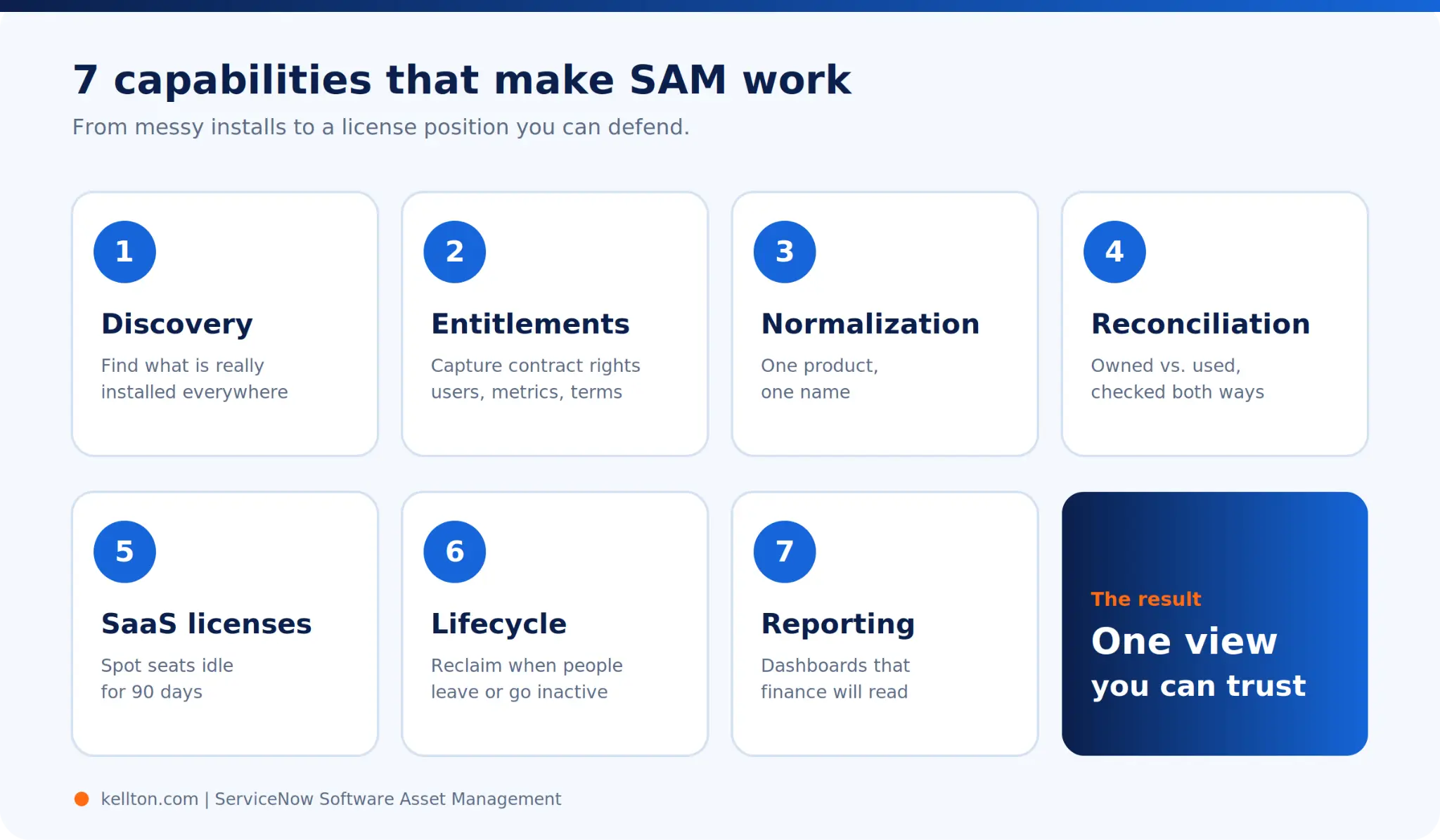
Implementing a robust software asset management program requires more than just basic tracking, it demands a strategic approach to software governance. Here are seven core ServiceNow SAM features that help U.S. enterprises eliminate wasteful spend, streamline compliance, and gain complete visibility over their software ecosystem.
1. Discovery that provides you with a genuine starting point
Optimizing can't be done without visibility. Discovery collects software on servers, endpoints, and in the cloud in a centralized location. The first time through is for most people demoralizing. Undesirable software appears. Unwanted software arrives. Older versions continue to be in place. Silently, test environments are eating production licenses.
2. Not only invoices, but entitlements as well
Purchase Orders are not guarantees. What is being granted to you through the contract is the entitlement: How many users is it for, which measurement, environments, rights to upgrade, rights to downgrade. With ServiceNow SAM you can capture those rights in a structured manner and compare against what is deployed.
This is also where negotiating power comes from. When you walk in a renewal and you know that you have used 640 out of 1000 seats, it's a different discussion than if you were to say “we think we use most of them.”
3. Normalization
Unglamorous and critical. If you see the same product five times in the same report, then all the reports downstream are incorrect. All other components of the system are built on good normalization.
4. Reconciliation and compliance
Reconciliation is a place where owned and used collide. Over-deployed? It can be corrected in time of an auditor. Under-used? You'll get that money back! It is bidirectional, hence the SAM teams' preference for it.
ServiceNow provides publisher-specific content for key vendors like Microsoft, Oracle, SAP and Adobe, and the rules for each vendor's licensing metrics are managed, not hand-coded in a spreadsheet. Note that coverage may vary per release; compare with your current list of vendors.
5. SaaS license management
The traditional "count installs" model has fallen out of favor with SaaS. The key to the matter is who's in and who's who out and when. ServiceNow's SaaS license management can be integrated with subscription applications to retrieve usage and user information, allowing you to determine who has a seat that hasn't been used for 90 days.
6. Lifecycle automation
Request, Approve, Assign, Renew, Reclaim, Retire. With these steps in workflows, rather than emails, licenses don't get lost. The simplest early win we've seen is to have a license reclaimed when a user leaves or becomes inactive.
7. Reporting that finances will actually read
A good dashboard has answers to the questions that leadership asks: What's our spending by vendor? What's coming up for renewal in the next 120 days? What are the over- or under-licensed situations in this country? What have we lost over the past three months?
Compare and contrast the differences between spreadsheets and ServiceNow SAM.
You don't have to hate spreadsheets. For companies of this size, they're okay. The problems begin if the environment is changing at a rate that is faster than people can update the file.
| Feature / Metric | Create a spreadsheet or manually track the data. Use a spreadsheet or track manually. | ServiceNow SAM |
|---|---|---|
| Accuracy | Fails to keep up to date within weeks | Continuously refreshed |
| Audit prep | Weeks of contract scrambling and counting | Position will be available on an as-needed basis |
| SaaS visibility | Anything recorded by the user | Usage and spending are tied to users |
| License reclaim | Occasionally, manual cleanup | Automated through workflows |
| Cross-team use | One person's file | The IT, procurement, finance, or security teams provide shared access |
| Scales to | Dozens of products | Thousands of products and publishers across the globe. |
Does SAM save money (or not)?
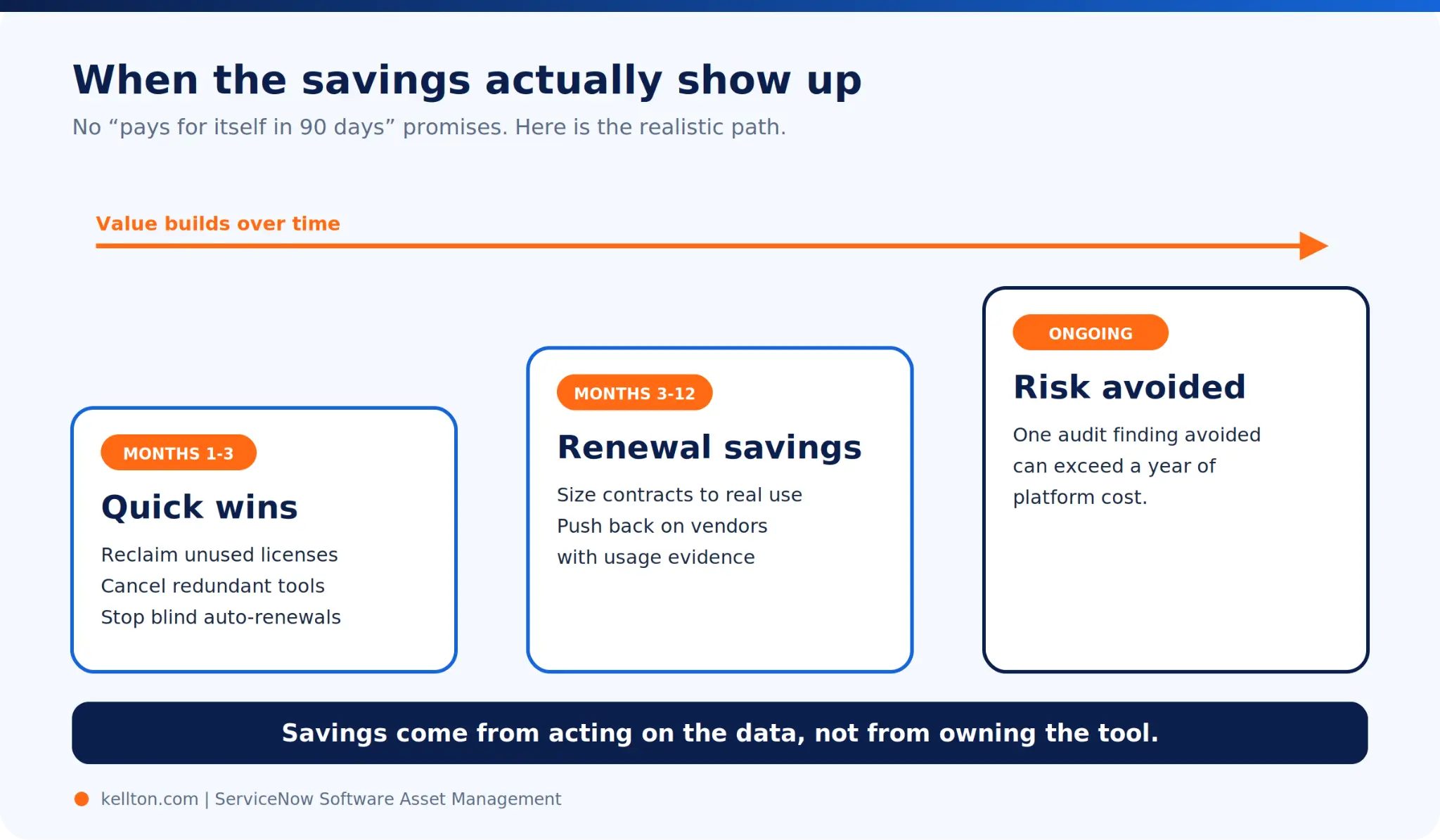
Don't fall for any software asset management promise that says "it pays for itself in 90 days. Sometimes it does. Far more frequently, the savings occur in some fashion such as this:
- Pumping up the revenue (first few months): reclaim unused licenses, cancel redundant, easy-to-identify licenses, and prevent auto-renewal of licenses not used.
- Renewal savings (months 3-12): real usage data to size contracts appropriately and evidence to push back vendors.
- Risk avoidance (ongoing): This is the most difficult to quantify, but one audit finding avoided can exceed the costs of a year of platform.
What's common is that the savings are realized by doing something with the data, rather than owning the tool. An empty SAM platform is a useless spreadsheet!
What do we see go wrong in real SAM projects?
At Kellton, we collaborate with businesses that are creating or fixing their SAM initiatives, and the errors recur. Here are the ones we would warn you about!
- Attempting to reach all of the publishers in one day. Teams collect 200 vendors, and are inundated with dirty data. Build the initial three to five publishers around the highest cost and risk items, typically Microsoft, Oracle, Adobe, SAP, or the largest SaaS contracts.
- Skipping data quality. Any reconciliation that is based on incomplete discovery or an unreliable CMDB will generate “confident-looking nonsense.” Solve the input problems first.
- Handling it as an IT project. The contracts are assigned to procurement. The budget is in the hands of Finance. Security is concerned about what is installed. Without them, the program fails to renew at the first renewal.
- Never defining an owner. Someone needs to be at the helm of the ownership of the entitlement records and also review compliance positions monthly. The platform will NOT handle it.
- Waiting to deal with SaaS until a crisis. 80 applications vs 400 can be more easily kept in check with SaaS sprawl.
Include a brief anonymized example of an engagement with Kellton, such as: industry, starting problem (what was not working), what was recovered or avoided, and timeline. For real numbers, it will be better than anything generic.
Looking to find out what your software spend is?
Whether you think you're paying for more than you're consuming or you prefer to discover licensing gaps before your vendor does, we can assist you. Get a free SAM maturity assessment, and we'll examine your current software asset environment and illustrate where the greatest savings and risks are. Talking to a Kellton ServiceNow expert.
Use these exercises to get started: Crawl, walk, run.
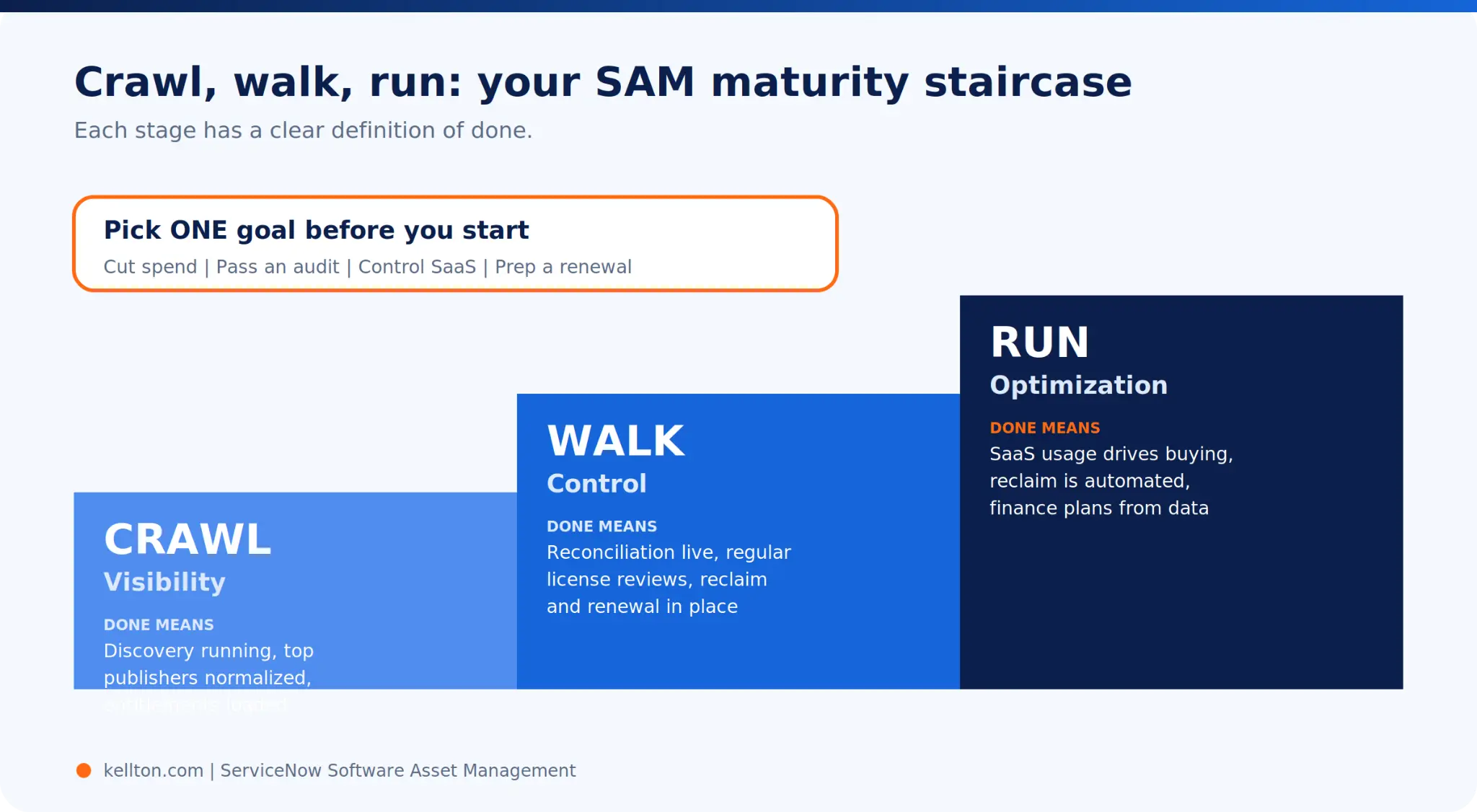
ServiceNow has a maturity journey of Crawl, Walk, and Run, and it's a logical sequence of work.
| Stage | Focus | The meaning of "done" |
|---|---|---|
| Crawl | Visibility | There was discovery running, key publishers were normalized, and your top vendors were loaded with entitlements. |
| Walk | Control | Reconciliation is in place, and positions for licenses are reviewed regularly; reclaim and renewal processes are in place. |
| Run | Optimization | SaaS usage forces buyers, automates reclaim, finances, and procurement based on the information in planning |
Prior to you start, select one aim. The first steps vary a little depending on what you are trying to accomplish, such as reducing spending, auditing, controlling SaaS, and preparing for a large renewal. The four are a hard combination to do all at once.
Frequently asked questions
Q1. What is ServiceNow Software Asset Management (SAM)?
Ans. It's a series of features on the Now Platform that enable organizations to find software, monitor license usage, audit against the software they own, manage SaaS use and automate the software lifecycle.
Q2. What's the difference between SAM and ITAM?
Ans. IT Asset Management includes hardware, software, and other assets. The software-specific component, which is related to software licensing, compliance, and cost, is Software Asset Management. In ServiceNow, they work together and share data with the CMDB.
Q3. Is there a ServiceNow SAM to support vendor audits?
Ans. Yes. Having all entitlements, deployments, and usage consolidated will give you an overview of your license position prior to any audit and correct any license gaps at an early stage. It does not take the place of legal or licensing guidance, but eliminates the majority of the manual evidence collection.
Q4. Does it have the capability to handle SaaS subscriptions?
Ans. Yes. SaaS license management integrates usage and user information into the subscription applications to provide you with seat availability and duplicate tools.
Q5. What will be the duration of implementation?
Ans. This is dependent on scope, data quality, and the number of publishers one launches. In a few months, a focused first phase utilizing a handful of vendors is realistic, a full program over a longer period.
Q6. What edition are we looking for?
Ans. ServiceNow offers SAM under various tiers (more advanced in the ServiceNow Professional tier). Right depends on vendor mix, SaaS footprint, and reporting requirements, as well as licensing conditions, which are subject to change – verify with your ServiceNow account team or partner.
Final thoughts
Major companies don't suffer from software issues. They suffer from a visibility issue, which manifests itself as a software issue: unexpected renewals, unexplainable invoices, and audit letters for bad weeks.
That's not something that ServiceNow SAM can do. It provides one view you know you can rely upon, so you can make decisions based on data, not habit, when it comes to renewals, consolidation, and compliance. Start small, get the inputs right, involve procurement and finance early, and let the savings build up over time.
Need assistance in creating a ServiceNow SAM roadmap? Kellton can grasp your existing ecosystem and prioritize your highest risk and highest cost publishers, as well as help you develop the processes to make the data useful.