Your engineering teams have adopted CI/CD pipelines, infrastructure as code, and shared responsibility for production systems. Yet developers still wait for infrastructure approvals, teams maintain similar deployment scripts, and senior engineers repeatedly solve configuration problems that other teams have already addressed.
The challenge may not be a lack of DevOps maturity. It may be the difficulty of scaling effective engineering practices across a growing organization.
DevOps establishes how teams build, deliver, and operate software. Platform engineering turns frequently needed engineering capabilities into supported, reusable services that developers can access through self-service workflows. Together, they can reduce duplicated effort, Platform engineering turns frequently needed engineering capabilities into supported, reusable services
Read more: how platform engineering accelerates DevOps. improve delivery consistency, and help engineering organizations scale without centralizing every technical decision.
This guide explores platform engineering vs DevOps, explains where each approach delivers the most value, and shows how enterprises can combine them to reduce engineering friction. You will learn how to evaluate an internal developer platform, build a business case, validate the investment through a 90-day pilot, and measure its impact on delivery performance, developer experience, and operating costs.
Key takeaways:
- DevOps establishes delivery and operational practices, while platform engineering makes selected capabilities reusable.
- An internal developer platform can reduce repetitive work and provide consistent infrastructure, security, and delivery workflows.
- Platform engineering complements DevOps rather than replacing it or transferring application ownership to a central team.
- Investment decisions should reflect measurable bottlenecks, developer needs, and the cost of maintaining shared capabilities.
- A focused pilot helps validate the business case before an organization expands its platform engineering investment.
Platform Engineering vs. DevOps: Key differences
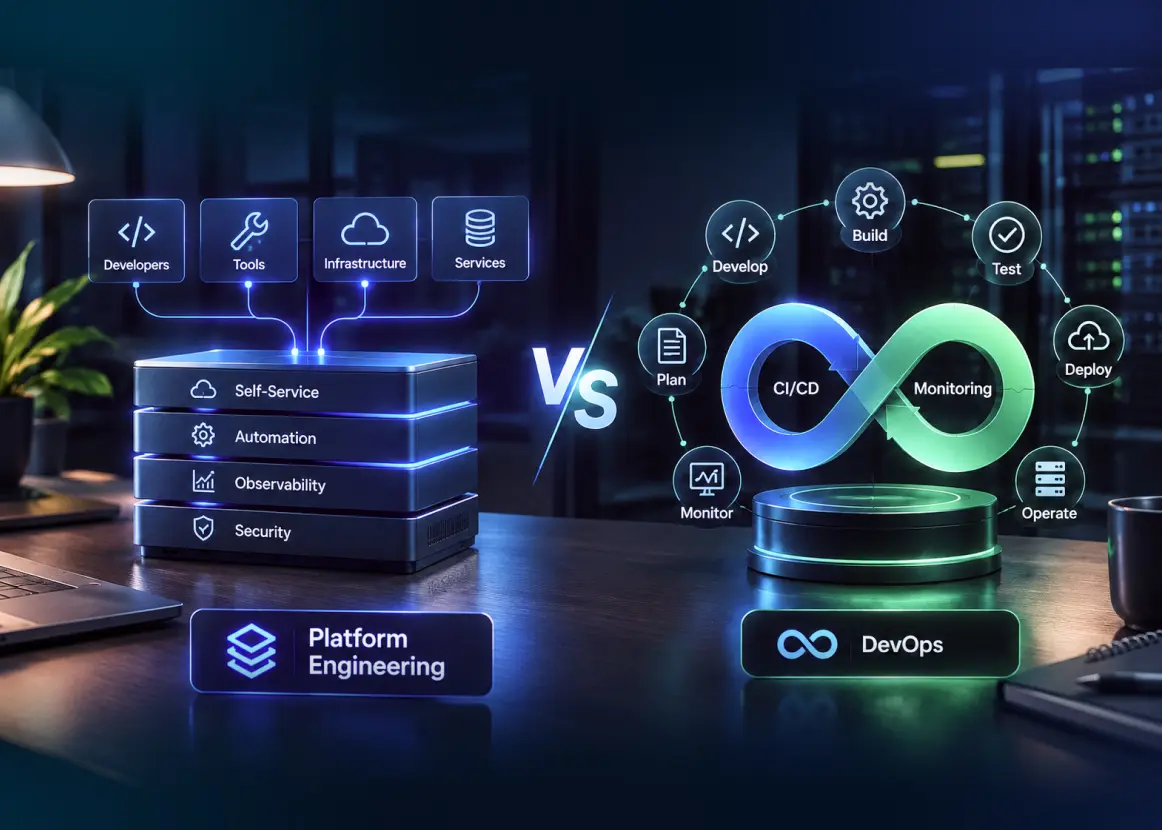
When evaluating DevOps vs platform engineering, it is important to distinguish between the practices used to deliver and operate software and the shared capabilities that help teams apply those practices consistently. DevOps emphasizes collaboration, automation, continuous feedback, and shared responsibility across software delivery and operations. Platform engineering applies product management and software engineering principles to the internal services developers need to build, deploy, and operate applications.
Here’s a quick comparison:
| Dimension | DevOps | Platform engineering | Value when combined |
|---|---|---|---|
| Primary focus | Improving software delivery and operational performance | Providing reusable engineering capabilities as an internal product | Scaling effective practices across teams |
| Core approach | Automation, collaboration, continuous feedback, and shared ownership | Self-service workflows, platform APIs, golden paths, and reusable services | Less duplicated implementation and coordination |
| Typical responsibilities | CI/CD, automated testing, deployment, observability, incident response, and operational ownership | Developer portals, service templates, infrastructure provisioning, platform APIs, and reusable controls | More consistent engineering workflows |
| Team responsibilities | Development and operations collaborate on delivery and production outcomes | Platform teams own shared capabilities; product teams retain application ownership | Clear boundaries with appropriate team autonomy |
| Potential limitation | Teams may independently build and maintain similar solutions | Poorly designed platforms can introduce friction or standardize ineffective practices | Shared capabilities reinforce effective delivery practices |
| Success measures | Deployment frequency, lead time for changes, change failure rate, and recovery time | Adoption, self-service completion, developer experience, reliability, and platform operating cost | Better delivery outcomes relative to engineering effort |
The distinction is not simply about the tools each team uses. DevOps is an approach to organizing software delivery and operations. Platform engineering is a discipline for designing, building, and operating internal services that help development teams work effectively.
For example, a DevOps team might establish automated testing, deployment pipelines, production monitoring, and incident response procedures. A platform team can package appropriate parts of these workflows into supported templates and services that product teams can use without rebuilding the underlying implementation.
The platform team maintains the shared capabilities and their service quality. Product teams remain responsible for their applications, including application-level security, reliability, and production outcomes. Exact ownership boundaries depend on the organization's operating model.
Platform engineering scales selected engineering practices through reusable capabilities. DevOps principles ensure those capabilities support effective delivery and operational ownership.
Why is DevOps and Platform Engineering not enough when used separately?
The case for combining the two disciplines depends on the problems an organization is experiencing. Three common situations illustrate where additional investment may help.
- DevOps without platform engineering: Effective practices, duplicated effort
An organization may have reliable CI/CD pipelines, automated testing, infrastructure as code, and observability. However, individual teams may maintain separate pipeline configurations, infrastructure modules, deployment scripts, and operational procedures.
As the organization grows, these parallel implementations create additional maintenance work. Security controls can become inconsistent, changes require coordination across repositories, and infrastructure specialists may spend time handling requests that could be automated.
The opportunity: Platform engineering can consolidate frequently needed capabilities into supported services, reducing duplicated maintenance while allowing teams to retain control over application-specific requirements.
- Platform engineering without effective delivery practices: Standardization without reliability
An internal developer platform cannot compensate for unreliable tests, unclear production ownership, inadequate monitoring, or poorly defined deployment procedures.
Automating these weaknesses can make them easier to reproduce without making the underlying process more reliable. A self-service deployment workflow, for example, offers limited value if applications lack appropriate release validation or teams cannot diagnose production failures.
The opportunity: Strengthen the relevant delivery and operational practices before encoding them into shared workflows. Where foundational practices are already sound, platform engineering can help make them easier to adopt consistently.
- Both disciplines without strategic alignment: More tooling, limited value
Even organizations with mature DevOps practices and dedicated platform teams can struggle when platform development is driven by technology choices rather than recurring developer problems.
A portal that still requires manual approvals for routine tasks, templates that cannot accommodate legitimate workload differences, or services that developers avoid can add operating costs without reducing friction.
The opportunity: Prioritize platform capabilities using developer feedback, support requests, workflow data, and operational evidence. Measure whether the platform removes meaningful obstacles rather than treating feature counts or registrations as proof of success.
The underlying principle is straightforward: effective delivery practices and a well-engineered platform must address real organizational needs. Neither the adoption of DevOps tools nor the launch of an internal developer platform guarantees better business outcomes.
How DevOps and Platform Engineering work together?
Consider a developer launching a new production service in an enterprise environment.
Without an integrated workflow, the developer may need to configure a repository, create a CI/CD pipeline, request infrastructure, arrange access permissions, configure monitoring, and verify security requirements. Individual tasks may already be automated, but the developer must still coordinate separate systems and resolve gaps between them.
A well-designed internal developer platform can bring these capabilities together through a supported workflow. The developer selects an approved service template, supplies the required configuration, and initiates provisioning and deployment through self-service interfaces.
The combined operating model has four parts.
- Establish dependable delivery practices. DevOps practices define how teams build, test, release, monitor, and support applications. These practices also establish feedback loops for improving reliability and delivery performance.
- Package repeatable capabilities. The platform team provides reusable infrastructure modules, service templates, deployment workflows, and policy controls. These components are versioned, maintained, documented, and supported as internal products.
- Enable self-service with appropriate guardrails. Product teams use approved workflows for routine tasks, with automated policy enforcement and approval steps where risk requires them. Teams retain responsibility for their applications rather than handing over every operational decision.
- Improve the platform using evidence. Developer feedback, service reliability, deployment performance, support demand, and usage patterns help identify which capabilities need improvement or further investment.
The result is a model in which common tasks follow supported paths without requiring every application to use an identical architecture. Standardization applies where it creates value, while teams can choose alternative approaches when workload requirements justify the additional complexity.
Platform engineering vs DevOps: Technologies that can support the model
The appropriate technology stack depends on the existing environment, security requirements, cloud strategy, and engineering workflows.
| Capability | Example technologies | Role in the combined model |
|---|---|---|
| Developer portal and service catalog | Backstage | Provides a discoverable interface for services, templates, documentation, and ownership information |
| Infrastructure as code | Terraform, Pulumi | Enables repeatable infrastructure provisioning and configuration |
| Continuous delivery | Argo CD | Supports declarative application deployment and reconciliation, particularly in Kubernetes environments |
| Policy as code | Open Policy Agent | Evaluates policies that can enforce or inform infrastructure and deployment decisions |
| Observability | OpenTelemetry | Provides instrumentation and telemetry standards for monitoring application behavior |
These technologies are examples rather than a prescribed stack. An internal developer platform may integrate existing CI/CD systems, cloud services, identity providers, secrets management, artifact repositories, and monitoring tools instead of replacing them.
The architecture should be driven by the workflows developers need and the capabilities the organization can realistically maintain. A developer portal alone does not constitute a complete platform; the underlying services, integrations, automation, documentation, and ongoing support determine its practical value.
Evaluate your platform engineering maturity, identify bottlenecks, and discover opportunities to improve developer productivity.

When should enterprises invest in DevOps, Platform Engineering, or both?
The right investment depends on the source of engineering friction. Platform engineering is not automatically the next step for every organization pursuing DevOps maturity.
| Current challenge | Recommended priority | How the approach should work |
|---|---|---|
| Manual releases, unreliable testing, or unclear production ownership | Strengthen DevOps foundations | Improve delivery automation, testing, observability, and accountability before scaling the affected workflows |
| Reliable CI/CD, but duplicated pipeline and infrastructure maintenance | Combine DevOps with platform engineering | Consolidate repeatable capabilities while preserving application-specific flexibility |
| Frequent provisioning requests and infrastructure specialist bottlenecks | Pilot self-service platform services | Automate common requests and connect provisioning with identity, security, deployment, and monitoring workflows |
| Inconsistent security controls across development teams | Integrate security into delivery and platform workflows | Define appropriate controls and enforce them consistently through automation and policy checks |
| Low platform adoption or restrictive templates | Improve platform usability and service design | Investigate unmet developer needs, remove unnecessary friction, and provide supported alternatives |
| Mature delivery practices across many teams, with rising coordination and maintenance costs | Develop a platform product strategy | Prioritize shared services according to demand, operating cost, reliability, and expected business value |
The appropriate organizational structure also varies. A smaller engineering organization may need only a shared infrastructure module, documented deployment templates, and automated provisioning. A larger enterprise with many product teams, cloud environments, and regulatory requirements may benefit from a dedicated platform team with a product roadmap, service catalog, defined service levels, and ongoing operational ownership.
The decision should reflect the economics of reuse. A shared capability is worthwhile when its benefits across consuming teams justify the cost of building, securing, supporting, and evolving it.
How to build the business case for combining DevOps and platform engineering?
The business case for combining DevOps and platform engineering should connect a specific engineering bottleneck to a measurable business outcome. Rather than assuming an internal developer platform (IDP) will automatically increase productivity, quantify the effort teams currently spend on repetitive work and estimate how reusable platform capabilities could reduce it.
Start by identifying recurring activities such as maintaining duplicate CI/CD pipelines, provisioning standard environments, troubleshooting configuration inconsistencies, and preparing security compliance evidence. Estimate the engineering hours these activities consume, identify which tasks can realistically be standardized, and establish a baseline before investing in platform development.
Consider a hypothetical organization with 100 developers who each spend four hours per week on infrastructure and delivery tasks that could be simplified through shared platform capabilities.
| Assumption | Value |
|---|---|
| Developers in scope | 100 |
| Targeted work per developer per week | 4 hours |
| Working weeks per year | 48 |
| Loaded engineering labor cost | $100 per hour |
| Estimated reduction in targeted work | 25% |
The annual labor capacity consumed by these activities is:
100 developers × 4 hours × 48 weeks × $100 = $1.92 million.
If platform engineering reduces the targeted workload by 25%, the organization could recover the equivalent of $480,000 in annual engineering capacity.
This figure represents potential capacity value, not guaranteed cash savings. The business benefit depends on whether teams redirect the recovered time toward product development, reliability improvements, security remediation, or other priorities that matter to the organization.
Account for the total cost of ownership
A credible business case must compare expected benefits with the full cost of building, adopting, and operating the platform.
- Implementation costs: Platform engineering, CI/CD and infrastructure integrations, migration, testing, documentation, and onboarding.
- Operating costs: Platform team staffing, cloud infrastructure, software licensing, maintenance, upgrades, and developer support.
- Adoption costs: Training, workflow changes, service migration, and handling workloads that do not fit standardized patterns.
- Operational risks: Deployment disruption, platform bottlenecks, excessive dependencies on the platform team, and the ongoing effort required to maintain reusable abstractions.
Also distinguish between capacity recovered and costs actually eliminated. Saving engineering hours does not reduce payroll unless it changes staffing or spending. However, recovered capacity can still create business value when it helps teams deliver planned product work sooner, reduce operational toil, or improve service reliability.
The strongest business case links a measurable source of duplicated engineering work to a realistic reduction, validates the estimate through a pilot, and compares the resulting benefits with the platform's total cost of ownership. This gives technology leaders a defensible basis for deciding whether to expand the investment, refine the approach, or stop.
How to validate the approach with a 90 Day Pilot?
A platform engineering initiative should prove that it can improve developer workflows without adding another layer of infrastructure, governance, or operational overhead. A 90-day pilot gives engineering leaders a practical way to test this before committing to a broader internal developer platform (IDP) rollout.
The objective is to validate one high-friction software delivery workflow, integrate it with the existing DevOps toolchain, and measure whether the resulting platform improves delivery efficiency, reliability, and developer experience.
Days 1 to 30: Establish the technical baseline
Select a recurring workflow that requires unnecessary manual effort, such as provisioning a new service, configuring a deployment pipeline, or implementing security and observability controls.
Assess the existing environment across:
- CI/CD: Pipeline templates, build and deployment automation, approval gates, and deployment failure rates.
- Infrastructure: Terraform or other infrastructure-as-code modules, environment provisioning, configuration drift, and access controls.
- Security: Secrets management, dependency scanning, policy enforcement, and evidence required for compliance.
- Observability: Standardized logs, metrics, traces, dashboards, and alerting.
- Developer experience: Provisioning lead time, number of manual handoffs, documentation gaps, and recurring support requests.
Establish baseline measurements before introducing new tooling. This helps distinguish improvements caused by the platform from changes in workload, staffing, or release frequency.
Days 31 to 60: Build one production-representative golden path
Choose a common application pattern, such as a containerized API deployed to an existing cloud or Kubernetes environment. Build a reusable workflow that enables a development team to provision, deploy, secure, and monitor the service through a consistent interface.
The implementation could include:
- A service template that creates the repository structure, build configuration, and required service metadata.
- Reusable CI/CD pipelines for testing, artifact creation, and deployment.
- Infrastructure-as-code modules for approved environments and resources.
- Automated security checks, secrets integration, and policy enforcement.
- Standardized observability configuration, including dashboards, alerts, and health checks.
- Role-based access, audit logging, and documented exception handling.
Integrate these capabilities with the organization's existing tools wherever practical. The goal is not to replace the DevOps toolchain or build a platform for every possible workload. It is to remove repeated engineering effort from one well-defined workflow while preserving appropriate team autonomy.
Test the golden path with two or three representative application teams. Track adoption, workflow completion, exceptions, developer feedback, and the effort required to maintain the platform.
Days 61 to 90: Validate outcomes and operational readiness
Compare the pilot results with the baseline. Evaluate whether the platform has reduced manual intervention and duplicated configuration without increasing deployment failures, security exceptions, or operational burden.
| Measure | What to evaluate |
|---|---|
| Provisioning lead time | Time from an approved request to a usable development or test environment |
| Deployment lead time | Time required to move a code change through the delivery pipeline |
| Developer effort | Manual steps and engineering hours required to onboard or deploy a service |
| Reliability | Change failure rate, rollback frequency, and recovery time where relevant |
| Standardization | Percentage of pilot services using approved pipeline, security, and observability configurations |
| Platform adoption | Successful use of the golden path and reasons teams bypass it |
| Platform operating cost | Engineering effort required to maintain templates, integrations, documentation, and support |
Use the results to make a scale, refine, or stop decision.
- Scale when teams adopt the workflow, repetitive effort decreases, and reliability and security remain acceptable.
- Refine when the technical foundation works but onboarding, usability, integrations, or exception handling create friction.
- Stop or redesign when the workflow does not address a meaningful bottleneck or the cost of maintaining the platform outweighs the demonstrated benefits.
A successful pilot does not automatically prove enterprise-wide ROI. It establishes evidence about adoption, engineering effort, reliability, and ongoing platform costs that leaders can use to estimate the value of expanding to additional teams and workloads.
Work with Kellton to identify an appropriate starting point, align DevOps and platform priorities, and define measurable outcomes for a potential pilot
Discuss Your Platform Engineering Roadmap
How to measure the combined impact of DevOps and Platform Engineering
Measuring the combined impact of DevOps and platform engineering requires more than tracking deployment frequency or internal developer platform adoption. Engineering leaders need to assess whether reusable workflows reduce repetitive work, improve delivery performance, maintain reliability, and justify the cost of building and operating the platform.
| Measurement area | Example metric | What it reveals |
|---|---|---|
| Developer productivity | Time from repository creation to first production deployment | Whether standardized workflows help teams move from setup to production faster |
| Engineering efficiency | Engineering hours spent on repeated provisioning, configuration, and pipeline maintenance | Whether platform capabilities reduce duplicated effort across teams |
| Delivery performance | Lead time for changes and deployment frequency | Whether teams can deliver software changes more efficiently |
| Reliability | Change failure rate, recovery time, and service level objective attainment | Whether delivery improvements preserve production stability |
| Platform effectiveness | Golden path adoption, self-service completion rate, and workflow abandonment | Whether platform capabilities address actual developer needs |
| Security and governance | Compliance with required controls and time needed to produce audit evidence | Whether shared workflows make security and governance more consistent |
| Platform economics | Platform development and operating costs compared with measured benefits | Whether the platform delivers sustainable business value |
Use established DORA metrics to evaluate software delivery performance, then combine them with developer experience, platform adoption, reliability, and cost data to understand the broader impact. Compare results against a baseline and account for differences in application complexity, team size, and workload.
No single metric proves success. Higher deployment frequency, for example, does not necessarily mean better outcomes if change failure rates rise or platform maintenance creates additional overhead.
The objective is to determine whether platform engineering makes effective DevOps practices easier to adopt and reuse, while DevOps feedback and operational data help platform teams continuously improve the developer experience and delivery process.
The Bottom Line: Combine DevOps and Platform Engineering Strategically
DevOps and platform engineering solve different parts of the software delivery challenge. DevOps establishes how teams build, deliver, and operate software. Platform engineering makes selected engineering capabilities reusable through supported, self-service workflows.
Enterprises that combine both strategically can reduce duplicated engineering work, improve consistency, and help teams scale delivery practices without sacrificing application ownership or flexibility. Achieving these outcomes requires more than adopting tools. It requires selecting the right capabilities, designing around developer needs, and measuring the results.
Kellton helps enterprises align DevOps modernization with platform engineering initiatives, from strengthening CI/CD pipelines and automating infrastructure provisioning to designing internal developer platforms and standardizing engineering workflows.
Whether your organization needs stronger DevOps foundations, a focused platform pilot, or a broader engineering roadmap, start by identifying the delivery bottlenecks that matter most to the business.
Frequently Asked Questions on platform engineering vs. DevOps
Q1. What is platform engineering vs devops?
Platform engineering vs DevOps comes down to their primary focus. DevOps is an approach to improving collaboration, automation, and accountability across software delivery and operations. Platform engineering builds and maintains reusable, self-service capabilities that help development teams apply effective engineering practices consistently. The two disciplines complement each other: DevOps establishes delivery and operational practices, while platform engineering makes selected capabilities easier to reuse across teams.
Q2. Is platform engineering replacing DevOps?
No. Product teams still need to own their applications, automate testing and delivery, monitor production, and respond to incidents. Platform engineering can reduce repeated infrastructure work by providing shared capabilities, but it does not eliminate the need for DevOps practices.
Q3. When should a company invest in platform engineering?
Consider it when multiple teams repeatedly maintain similar infrastructure workflows, depend on the same specialists, or experience delays from manual provisioning and inconsistent controls. First verify that the problem is substantial enough to justify the platform's implementation and operating costs.
Q4. Does platform engineering reduce engineering costs?
It can reduce duplicated effort and improve the use of engineering capacity. However, recovered capacity is not automatically a cash saving. A credible business case must account for implementation, ongoing operations, adoption, and the organization's ability to use the recovered time productively.
Q5. What is an internal developer platform?
An internal developer platform combines interfaces, APIs, automation, infrastructure capabilities, and policies that let developers complete common engineering tasks through supported workflows. A developer portal can provide the interface, but the platform also needs the capabilities that perform the underlying work.
Q6. How should organizations start platform engineering?
Start by identifying one recurring engineering problem, measuring its current cost, and selecting a common workload. Build a supported golden path with representative teams, compare results against the baseline, and expand only when the benefits justify the ongoing investment.