

Artificial intelligence is changing how software gets built, tested, deployed, and maintained. Developers can now generate code, tests, documentation, SQL queries, infrastructure configurations, and potential fixes in minutes. But faster code generation does not automatically translate into faster, safer software delivery.
The AI software development life cycle extends traditional software engineering by integrating AI across requirements, architecture, implementation, testing, deployment, operations, and continuous improvement. The shift is from AI assisting individual developers to AI executing governed engineering workflows.
AI-assisted coding is only the starting point. As enterprises adopt AI agents capable of planning tasks, accessing tools, and executing multi-step workflows, engineering teams need new ways to evaluate outputs, manage permissions, and maintain accountability.
This evolution raises an important question: why your AI product needs a different development lifecycle when its behavior can depend on model versions, prompts, retrieved context, external tools, and changing data.
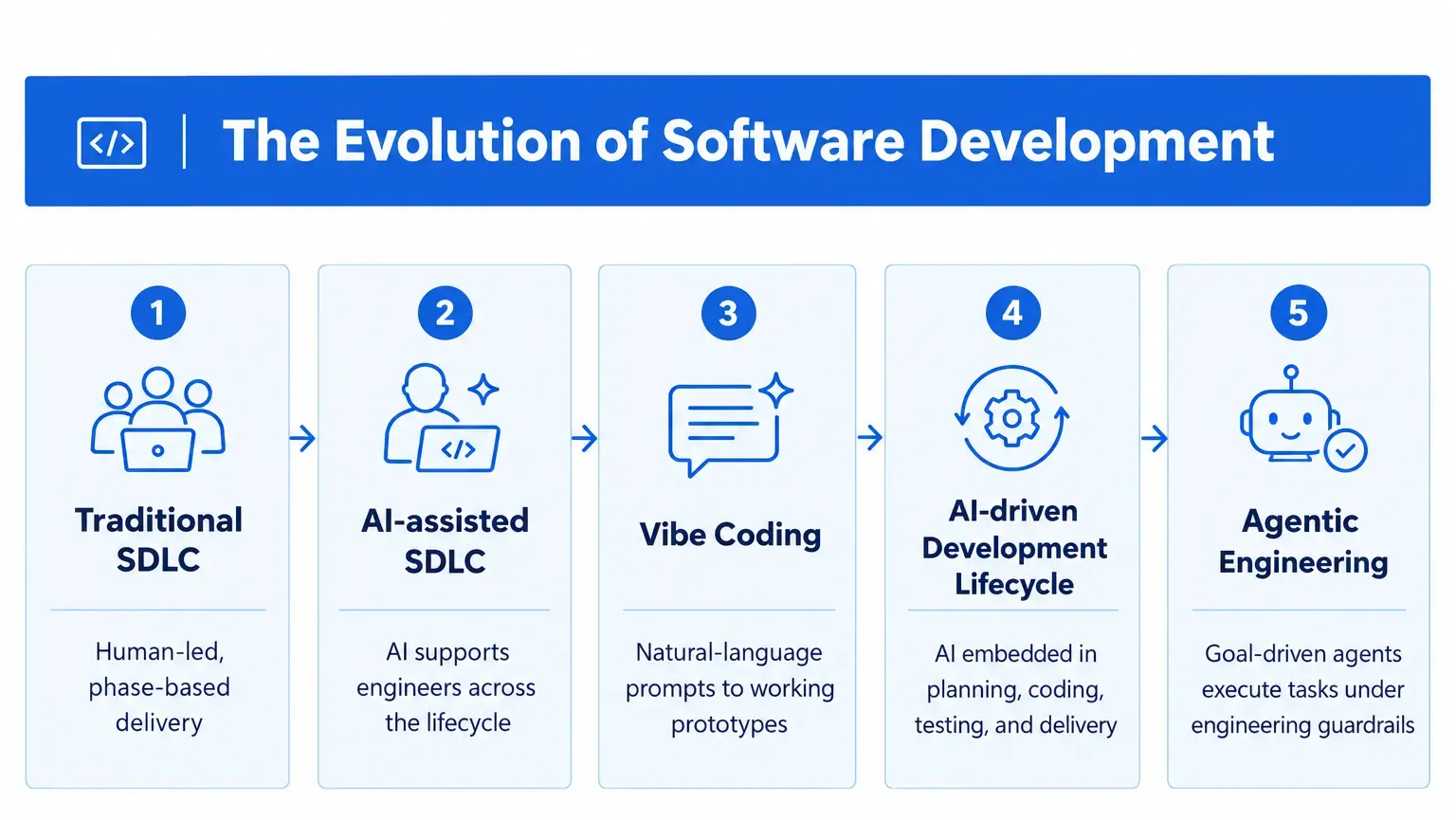
The AI software development life cycle addresses this challenge by integrating AI into requirements, architecture, implementation, testing, deployment, and maintenance. As teams adopt agentic engineering, the lifecycle must also govern systems that can plan tasks, use tools, execute workflows, and initiate changes with varying degrees of autonomy.
What is the AI software development life cycle?
The AI software development life cycle is a structured approach to planning, designing, building, testing, deploying, and maintaining software that integrates AI capabilities into engineering workflows. AI may assist developers with specific tasks, such as generating code or writing tests.
In more advanced implementations, AI systems can coordinate multiple tasks, retrieve relevant context, interact with development tools, and execute parts of an engineering workflow under defined permissions.
The AI Development Lifecycle brings AI capabilities into established engineering processes while retaining requirements management, version control, testing, security reviews, and release governance. Depending on the use case, it may involve AI-assisted coding, automated test generation, intelligent defect analysis, or agents that execute approved engineering tasks.
The lifecycle still depends on established software engineering practices. Requirements, architecture, version control, code review, testing, deployment controls, monitoring, and maintenance remain essential. What changes is how teams perform these activities and the controls they need for AI-generated outputs and autonomous actions.
For example, a conventional development team might write a service, create tests, and submit a pull request. An AI-enabled team might use an assistant to generate the initial implementation and tests, then evaluate the results against acceptance criteria, security policies, and regression suites before approving the change.
The goal is not to remove engineers from software development. It is to increase engineering capacity while maintaining accountability for the software that reaches production.
Identify where AI can improve your software delivery workflow and which controls are needed before scaling adoption.

What does the AI software development lifecycle change?
An AI-native SDLC retains established engineering disciplines while adding controls for AI behavior, context, agent execution, and model changes. Requirements, architecture, development, testing, deployment, and monitoring remain connected, but each stage must account for the additional variables introduced by AI.
| Lifecycle Concern | Traditional SDLC | AI-native SDLC |
|---|---|---|
| Requirements | User stories and acceptance criteria | Business requirements, expected AI behavior, failure conditions, and evaluation criteria |
| Architecture | Services, APIs, databases, and infrastructure | Traditional components plus models, agents, context, retrieval, memory, and tool interfaces |
| Development | Primarily human-written code | Human and AI-generated code, with review and validation controls |
| Testing | Unit, integration, regression, and performance tests | Conventional testing plus model evaluation, agent behavior testing, and adversarial scenarios |
| Security | Application, infrastructure, identity, and data security | Traditional security plus prompt injection, unsafe tool use, model access, and agent permissions |
| Deployment | CI/CD pipelines with automated quality gates | CI/CD plus AI evaluation, policy enforcement, risk-based approvals, and model configuration checks |
| Monitoring | Application logs, infrastructure metrics, and traces | Traditional telemetry plus model behavior, retrieval quality, tool calls, agent traces, and AI-specific costs |
| Change Management | Version-controlled code, dependencies, and configuration | Code and dependency versioning plus model, prompt, context, evaluation dataset, and agent configuration versioning |
The practical implication is that AI quality cannot be established once and assumed to remain stable. Changes to models, prompts, retrieval sources, tools, or agent workflows can introduce new failure modes, even when the underlying application code remains unchanged.
An AI-native SDLC is therefore more than a faster development process as it controls the enterprise systems designed to keep AI behavior measurable, secure, and reliable as the product evolves.
The 7 stages of the AI software development life cycle
An AI-enabled lifecycle retains the core structure of software engineering while introducing AI-specific evaluation and control mechanisms.
Stage 1: Requirements analysis and planning
A software project can fail before the first line of code is written if requirements are incomplete, contradictory, or disconnected from business outcomes. AI can help teams analyze requirements faster, but it cannot reliably resolve every ambiguity without stakeholder input.
Engineering teams can use AI to:
- Summarize stakeholder interviews and existing documentation.
- Convert business requirements into draft user stories.
- Identify missing acceptance criteria and conflicting requirements.
- Generate initial edge cases and failure scenarios.
- Map requirements to measurable outcomes.
For AI-enabled features, teams must define expected behavior and acceptable failure conditions in addition to conventional functional requirements. An effective AI development methodology connects business requirements to measurable engineering outcomes. Teams should define expected behavior, acceptance criteria, failure conditions, data requirements, and escalation rules before allowing AI systems to influence implementation decisions.
Consider an enterprise support application that uses AI to summarize customer cases. Its requirements should cover not only summary generation but also source accuracy, access restrictions, handling of missing information, and behavior when the underlying records conflict.
What to establish before moving forward: Approved requirements, measurable acceptance criteria, identified risks, and a clear definition of success.
Stage 2: Architecture and system design
AI-generated code cannot compensate for an architecture that lacks clear boundaries, secure interfaces, or appropriate data access controls. During design, AI can help explore alternative architectures, generate diagrams, document APIs, identify dependencies, and review design proposals. Engineers must still evaluate these outputs against the organization's existing systems and constraints.
An AI-enabled architecture may need to account for:
- Model and service dependencies.
- Retrieval and context management.
- Agent orchestration and tool interfaces.
- Identity, authorization, and data access.
- Logging, observability, and auditability.
- Failure handling, latency, and cost limits.
When an application includes custom or fine-tuned models, the AI model development life cycle must also account for data preparation, model selection, training or fine-tuning, evaluation, deployment, and ongoing monitoring. These activities should align with the wider application lifecycle so that model changes do not undermine application reliability or security.
What to establish before moving forward: A reviewed architecture, defined integration boundaries, security requirements, and documented failure-handling strategies.
Stage 3: Development and implementation
AI-assisted coding is often the most visible entry point for AI in software engineering. Developers can use AI tools to generate code, explain unfamiliar modules, refactor existing implementations, write documentation, and propose fixes.
The productivity opportunity is meaningful, but generated code should not automatically be treated as correct, secure, or maintainable.
A controlled implementation workflow should include:
- Give the AI tool the relevant requirements, repository context, and coding standards.
- Generate a focused change rather than an unrestricted implementation.
- Run formatting, static analysis, and automated tests.
- Review dependencies, permissions, error handling, and potential security issues.
- Require appropriate approval before merging the change.
For larger changes, teams should define which files, services, environments, and operations the AI system is permitted to modify.
The central principle is straightforward: AI can accelerate implementation, but the engineering process must determine whether the implementation is acceptable.
Stage 4: Testing, verification, and evaluation
Testing becomes more important, not less important, when AI increases the volume or speed of code production.
Traditional software tests remain essential for deterministic behavior. AI-enabled applications may also require evaluation methods that assess outputs against expected criteria rather than checking only whether a function returned a particular value.
A comprehensive strategy can include:
| Testing Layer | What It Verifies |
|---|---|
| Unit testing | Individual functions and components behave as expected |
| Integration testing | Services, APIs, databases, and external systems interact correctly |
| Regression testing | New changes do not break existing functionality |
| Security testing | Changes do not introduce vulnerabilities or unauthorized access |
| AI output evaluation | Model responses meet defined quality, accuracy, and relevance criteria |
| Agent workflow testing | Tool calls, task sequences, permissions, and recovery paths behave correctly |
| Performance testing | Latency, throughput, resource consumption, and cost remain within targets |
Latency, throughput, resource consumption, and cost remain within targets
For an AI application, evaluation datasets should represent realistic user inputs, edge cases, and known failure conditions. Teams should track quality over time as models, prompts, retrieval sources, and application code change.
For agentic systems, test both successful task completion and unsafe or incomplete behavior. An agent that completes a task correctly in a demonstration may still fail when a tool is unavailable, an API returns unexpected data, or a user requests an unauthorized action.
What to establish before moving forward: Documented test results, defined quality thresholds, resolved critical defects, and explicit approval criteria.
Stage 5: Deployment and release management
A successful development build does not guarantee a successful production release. AI-generated changes and AI-enabled features should pass the same appropriate release controls as other production software.
Teams can use AI to support release-note generation, deployment planning, configuration checks, change-risk analysis, and incident summaries. These capabilities should complement, not bypass, established deployment controls.
A controlled release process should include:
- Versioned source code and configuration.
- Automated build and test pipelines.
- Environment-specific access controls.
- Staged rollouts or canary deployments where appropriate.
- Rollback procedures and recovery plans.
- Human authorization for high-impact changes.
For AI-enabled applications, record the relevant model version, prompt or configuration version, retrieval configuration, and evaluation results where applicable. This makes it easier to investigate changes in behavior after deployment.
What to establish before moving forward: An approved release, a tested recovery path, production monitoring, and a clear owner for the deployment.
Stage 6: Monitoring, operations, and maintenance
The lifecycle does not end when the software is deployed. Production systems encounter changing data, evolving user behavior, dependency failures, security threats, and unexpected workloads.
AI can help engineering and operations teams analyze logs, group related incidents, summarize alerts, identify potential causes, and recommend remediation steps. Autonomous remediation requires additional controls, particularly when actions can affect customer data or business-critical systems.
For conventional application components, teams should monitor availability, latency, error rates, resource utilization, and security events.
For AI-enabled components, monitoring may also cover:
- Output quality and relevance.
- Model and provider failures.
- Retrieval quality and context freshness.
- Token consumption and inference cost.
- Policy violations and unexpected tool usage.
- Changes in model behavior or evaluation results.
For agentic workflows, audit which tools were invoked, what permissions were used, what actions were completed, and whether a task required human intervention.
Monitoring should trigger defined responses. A quality decline might lead to investigation or a configuration rollback. A security violation might require an immediate stop to the affected workflow.
Stage 7: Continuous improvement and optimization
The final stage closes the feedback loop between production performance and future engineering decisions.
Teams can analyze defects, support tickets, user feedback, performance data, evaluation results, and delivery metrics to identify improvements. AI may help summarize recurring issues and propose code changes, test cases, or documentation updates.
However, continuous improvement should be evidence-led. Teams need to distinguish a genuine improvement from a change that merely reduces development time while increasing defects, operating costs, or support effort.
Review the lifecycle regularly to determine:
Which AI-assisted tasks deliver measurable value.
Which changes create recurring quality or security problems.
Where additional automation is appropriate.
Which workflows should retain mandatory human approval.
Whether model, tooling, and infrastructure costs remain justified.
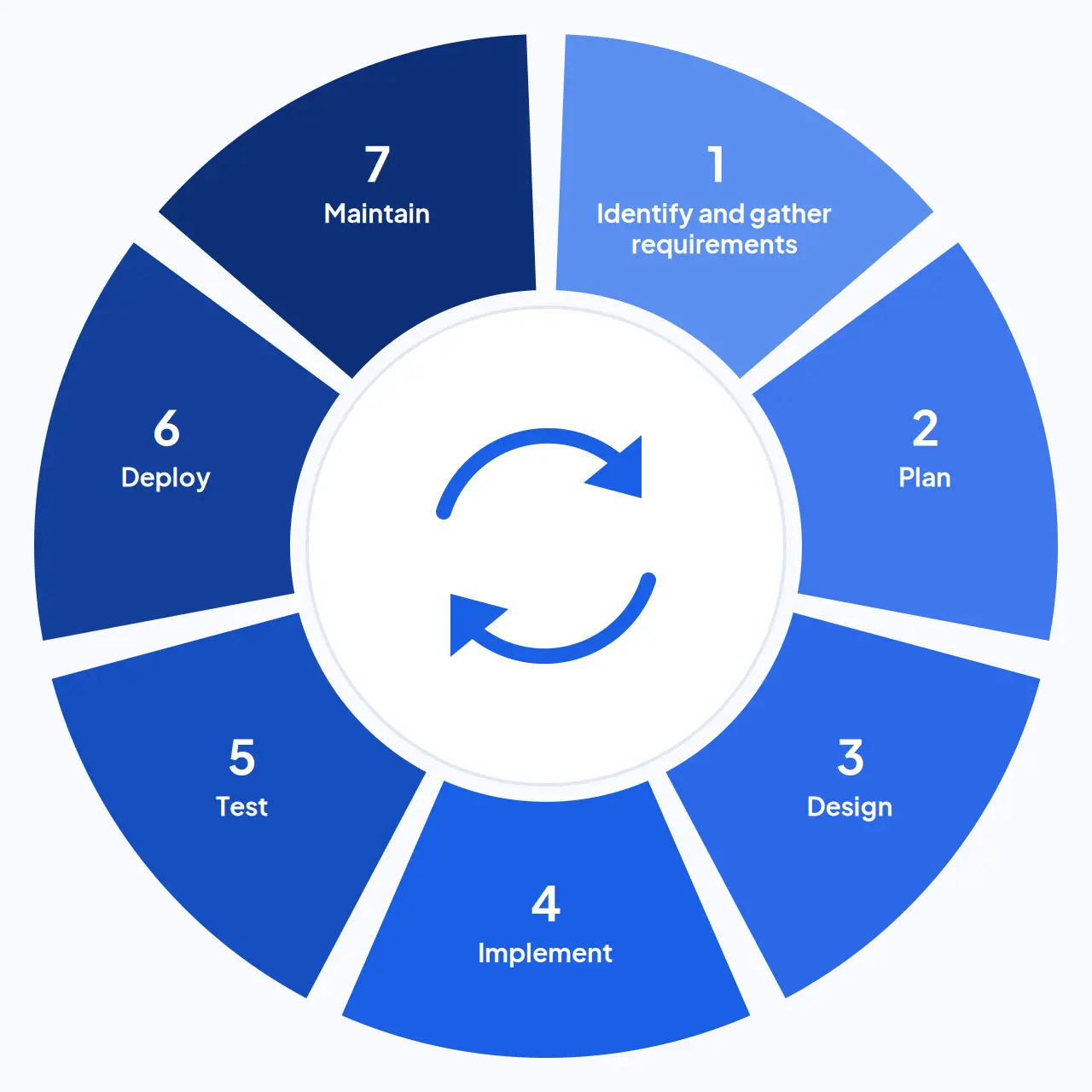
How are AI SDLC, vibe coding, AI-DLC, and agentic engineering different?
Not every approach to AI-driven development gives AI the same level of responsibility. Some use AI to accelerate individual coding tasks. Others integrate AI throughout the software development lifecycle or enable AI agents to perform complex, multi-step engineering tasks.
Understanding these differences helps engineering leaders choose an approach that balances development speed with code quality, security, maintainability, and operational risk.
| Approach | How AI is used | Human responsibility | Best suited for |
|---|---|---|---|
| AI-assisted SDLC | Supports coding, testing, documentation, debugging, and code analysis | Engineers direct development, review outputs, and make key decisions | Enterprise teams adopting AI within established workflows |
| Vibe coding | Generates applications rapidly from natural-language instructions and iterative feedback | Users guide implementation, test behavior, and validate results | Prototypes, proof of concepts, and low-risk internal tools |
| AI-DLC (AI-Driven Development Lifecycle) | Integrates AI across planning, design, implementation, testing, and delivery | Teams define business intent, establish guardrails, and oversee outcomes | Organizations seeking an AI-driven approach across the development lifecycle |
| Agentic engineering | Uses AI agents to execute multi-step engineering tasks through tools, feedback, and delegated workflows | Engineers establish permissions, supervise execution, and handle exceptions | Mature engineering teams automating complex, bounded workflows |
Why your AI product needs a different development lifecycle becomes clearer when its behavior depends on more than application code. Model updates, prompt changes, retrieval quality, tool permissions, and agent planning can all affect production outcomes. A lifecycle that evaluates only conventional code changes may miss these sources of risk.
AI-assisted SDLC introduces AI into existing engineering practices. Vibe coding prioritizes rapid implementation through conversational instructions. AI-DLC takes a lifecycle-wide approach, while agentic engineering focuses on AI agents capable of planning and executing sequences of engineering tasks.
The distinctions are conceptual rather than rigid industry standards, and implementations can overlap. An enterprise may use vibe coding for prototyping, AI-assisted SDLC for routine development, and agentic engineering for selected tasks within the same AI-DLC framework.
The critical mistake is moving from AI-generated code directly to autonomous execution without establishing the evaluation, authorization, and rollback mechanisms needed to control the additional risk.
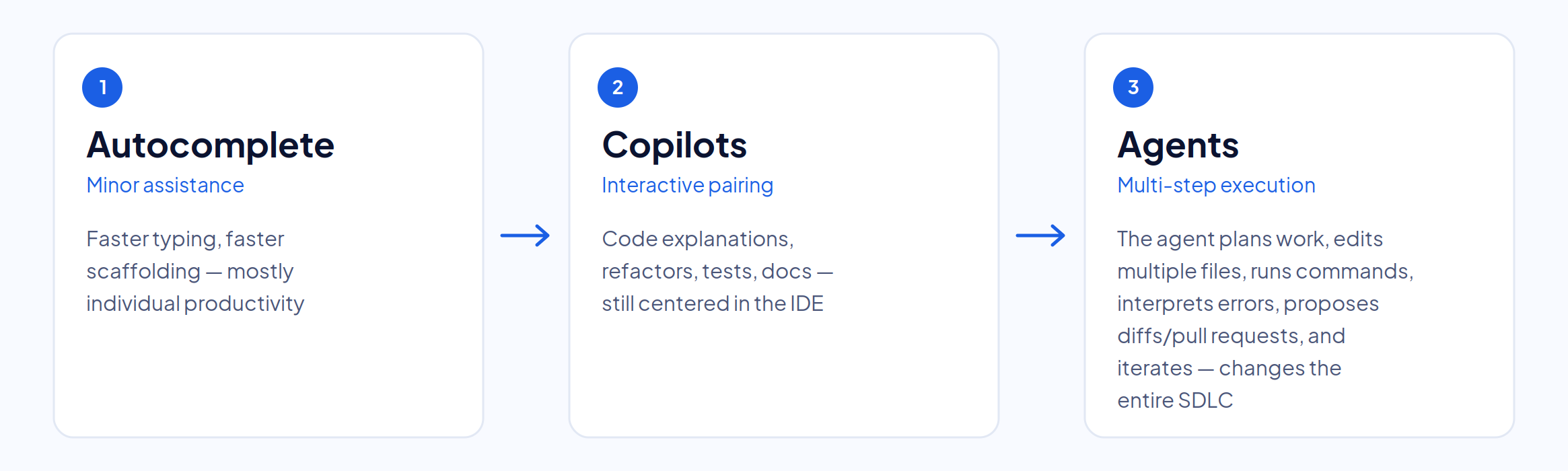
Where AI-DLC and agentic engineering fit?
AI-driven development lifecycle approaches, including AI-DLC, seek to reorganize development around greater AI participation in the work. Agentic engineering focuses on systems that can pursue defined goals through planning, tool use, execution, and feedback.
These concepts overlap, but they are not interchangeable.
AI-DLC describes a broader approach to organizing development work. Agentic engineering describes a way of building and operating AI systems that can execute multi-step tasks within defined boundaries.
The practical question for enterprise leaders is not which label to adopt. It is which responsibilities can safely move from manual execution to AI assistance or controlled autonomy.
A sensible progression is to begin with well-defined, low-risk tasks, measure their results, and expand autonomy only when testing, observability, access controls, and recovery mechanisms are adequate.
Discuss how to integrate AI capabilities into your existing applications, platforms, and engineering processes.
How MCP supports AI-enabled engineering workflows?
The Model Context Protocol (MCP) provides a standardized way for AI applications to connect with external tools and data sources through MCP clients and servers.
In software engineering, an MCP-enabled workflow may expose approved access to issue trackers, documentation, source-control systems, test tools, or development resources. This can help an AI assistant retrieve relevant context and interact with engineering systems without requiring a completely separate custom integration for every tool.
For example, an engineering assistant could retrieve an approved issue description, consult relevant documentation, propose a code change, and request a test run through available tools.
MCP does not automatically make an AI workflow secure, reliable, or autonomous. Each integration still requires appropriate authentication, authorization, input validation, output handling, and audit controls. Tool access should follow least-privilege principles, and consequential actions should require approval where appropriate.
The protocol provides a connection mechanism. The surrounding architecture and governance determine what the AI system is allowed to do.
Enterprise AI SDLC: A practical implementation example
Imagine a financial services organization that wants to accelerate updates to an internal customer-service application.
The team currently spends substantial time translating tickets into code changes, writing regression tests, reviewing dependencies, and preparing release documentation.
Instead of automating the entire development lifecycle at once, the organization introduces AI in stages.
| Workflow | AI-enabled approach | Required control |
|---|---|---|
| Ticket analysis | Summarize requirements and identify missing acceptance criteria | Product owner validates requirements |
| Code implementation | Generate a proposed change based on approved repository context | Developer review and source-control checks |
| Test creation | Suggest unit and regression tests | Automated execution and coverage review |
| Defect analysis | Summarize failing tests and suggest likely causes | Engineer validates the diagnosis |
| Release preparation | Draft release notes and summarize test evidence | Release owner approves the deployment |
| Production operations | Group alerts and recommend investigation steps | Existing incident controls govern remediation |
This approach improves selected workflows without granting an AI system unrestricted access to production.
The organization should establish a baseline before implementation and then compare the results against that baseline. Relevant measures include cycle time, review effort, escaped defects, test effectiveness, change failure rate, and engineering cost.
The outcome should be assessed across speed, quality, security, and total cost. Faster code generation alone is not sufficient evidence of a successful transformation.
How to measure AI SDLC performance and ROI?
AI engineering investments should be evaluated using operational evidence rather than tool usage or code volume alone.
| Metric | What to measure | Why it matters |
|---|---|---|
| Lead time for changes | Time from an approved change to production | Indicates delivery speed |
| Review effort | Time spent reviewing and correcting AI-assisted changes | Reveals whether generation creates additional work |
| Defect escape rate | Defects discovered after release | Helps assess production quality |
| Change failure rate | Share of deployments requiring remediation or causing failure | Tracks release reliability |
| Test effectiveness | Defects detected and relevant scenarios covered | Helps assess validation quality |
| AI operating cost | Model usage, infrastructure, tooling, and associated operating expenses | Supports cost control |
| Rework rate | Effort spent correcting or replacing generated outputs | Identifies low-value automation |
| Security incidents | AI-related policy violations, vulnerabilities, and unauthorized actions | Tracks risk exposure |
Measure these indicators before and after introducing AI. Compare similar tasks and account for changes in team size, project complexity, and delivery scope.
A practical ROI calculation is:
Net AI benefit = Measured productivity value + Avoided costs − AI implementation and operating costs
A measurable AI development methodology tracks whether AI adoption improves delivery performance without increasing defects, rework, security exposure, or total operating costs. Teams should assess these outcomes together rather than treating code generation speed as the primary success metric.
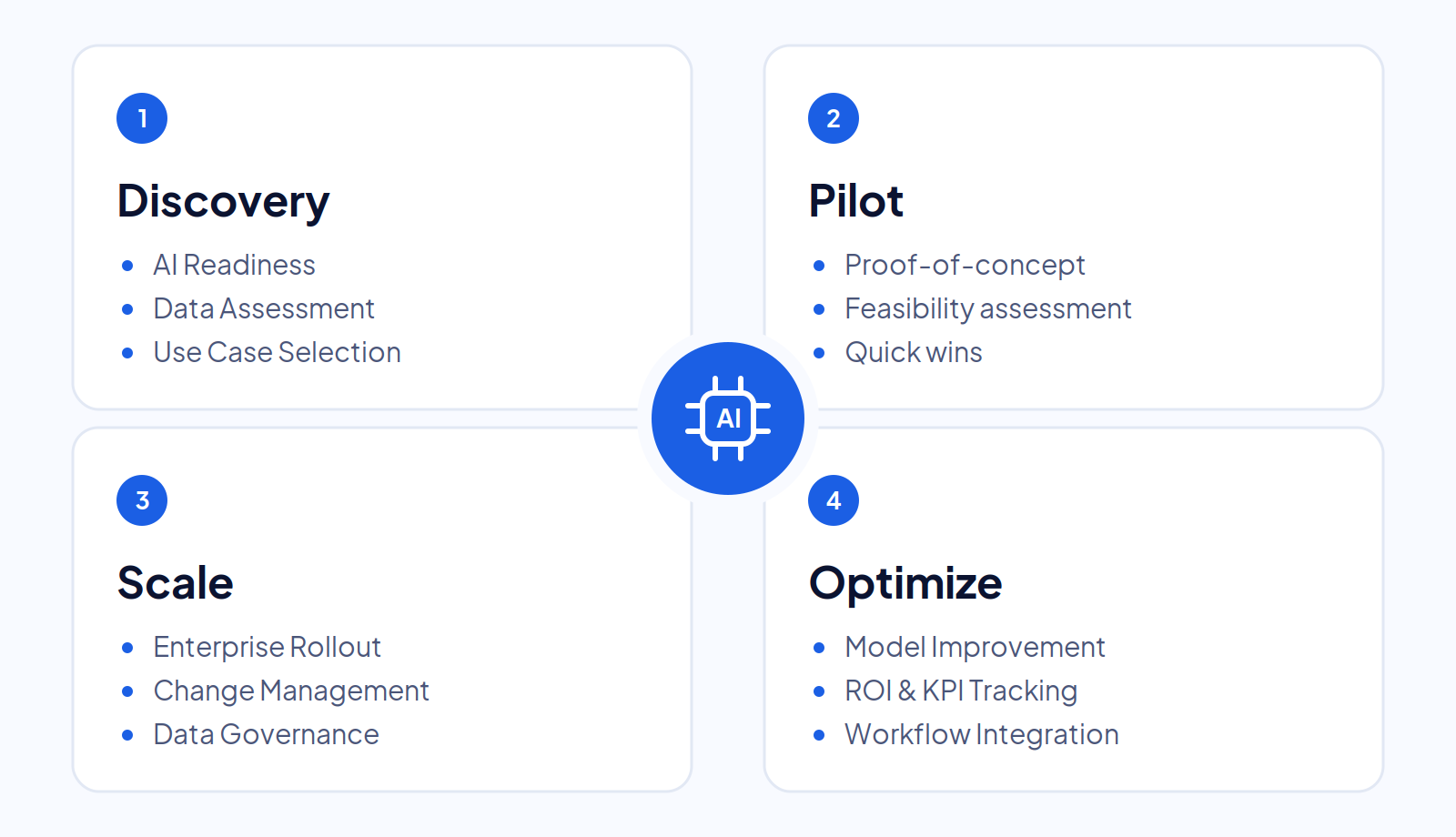
An enterprise roadmap for adopting the AI software development life cycle
Organizations do not need to automate every stage to benefit from AI-enabled engineering. A phased approach makes it easier to identify value and manage risk.
Phase 1: Assess readiness
Identify repetitive engineering tasks, existing delivery bottlenecks, security requirements, and measurable baseline metrics. Select a use case with clear boundaries and manageable risk.
Phase 2: Pilot AI-assisted workflows
Start with activities such as documentation, test generation, code explanation, or bounded code changes. Define review requirements and evaluate quality alongside delivery speed.
Phase 3: Integrate tools and governance
Connect approved development resources, establish access policies, improve automated testing, and implement audit logging.
Where MCP is appropriate, review every exposed tool and its permissions.
Phase 4: Introduce bounded agentic workflows
Allow agents to execute selected multi-step tasks under defined constraints. Begin with reversible operations and require explicit authorization for high-impact changes.
Phase 5: Scale using evidence
Compare pilot results against the baseline. Expand only when the organization can demonstrate acceptable quality, security, reliability, and cost.
What mistakes should enterprises avoid when adopting AI-SDLC?
Several implementation mistakes can undermine the benefits of AI-driven development.
- Treating vibe coding as a complete engineering strategy. Rapid prototyping does not replace architecture, testing, security, or maintainability requirements for production software.
- Expanding agent autonomy too quickly. Agents should earn broader permissions through demonstrated reliability, appropriate evaluation, and risk-based controls.
- Allowing AI to validate its own output without independent checks. Generated code and generated tests can share the same assumptions and blind spots.
- Ignoring context quality. Outdated documentation, inconsistent standards, and inaccessible system knowledge can reduce the effectiveness of every AI workflow.
- Measuring productivity through code volume. Generated output is not valuable if it increases defects, rework, or maintenance costs.
- Automating inconsistent processes. AI can reproduce process weaknesses at scale. Standardized workflows, environments, interfaces, and policies provide a stronger foundation for automation.
These mistakes point to a broader lesson: AI adoption should follow engineering readiness, not the availability of new tools.
How should CTOs choose between vibe coding, AI-DLC, and agentic engineering?
The decision depends on the type of work, the maturity of the engineering environment, and the consequences of failure.
| Situation | Appropriate approach |
|---|---|
| Rapid prototype or exploratory UI | Vibe coding |
| Routine coding, testing, and documentation | AI-assisted development |
| Production enterprise application | Governed AI-driven SDLC |
| Repeatable, well-defined engineering workflow | AI-DLC with bounded agentic automation |
| Multi-step task requiring tools and iterative execution | Agentic engineering within defined controls |
| High-risk production change | Governed agentic workflow with explicit approval |
| Sensitive or regulated system | Restricted AI execution with strong independent evaluation and oversight |
These are not exclusive choices. An enterprise can use vibe coding to validate an idea, AI assistance to develop the implementation, and an agent to prepare tests and a pull request, all within one AI-driven lifecycle.
The more consequential the action, the more explicit the permissions, validation, and approval requirements should be.
What should the target AI-native engineering architecture look like?
A mature architecture connects AI systems to the engineering environment through a governed control plane.
At a high level, engineering users interact with an AI interface or workflow orchestrator. Specialized agents perform planning, development, and validation tasks using authorized context and tools. Changes then pass through independent evaluation, security checks, governance policies, and delivery controls before reaching production.
Production telemetry feeds back into the evaluation and improvement process.
This architecture brings the preceding capabilities together:
- The context layer supplies relevant engineering knowledge.
- The agent orchestration layer coordinates multi-step work.
- The tool and identity layers enforce controlled access.
- The evaluation layer verifies results.
- The governance layer determines which actions are permitted.
- The delivery layer controls release and rollback.
- The observability layer informs continuous improvement.
The defining characteristic is that AI operates within the engineering system, rather than outside it. Its work remains subject to the same business objectives and engineering controls that govern production software.
How can Kellton help modernize your software development lifecycle?
Moving from AI-assisted coding to an AI-native software development lifecycle requires more than new tools. Enterprises need to connect AI capabilities with their existing applications, development pipelines, testing frameworks, and security controls without disrupting delivery.
Kellton helps enterprises modernize software engineering across three key areas: AI-powered development, engineering automation, and production readiness. This includes identifying repetitive engineering tasks suitable for AI assistance, integrating AI agents into development workflows, strengthening automated testing and CI/CD pipelines, and modernizing legacy applications to support evolving business requirements.
With capabilities spanning AI and agent engineering, data engineering, platform engineering, and DevOps, Kellton can help organizations connect AI initiatives with the underlying systems and workflows required to operationalize them. The focus is on reducing manual effort, improving development throughput, strengthening software quality, and maintaining the security and governance required for enterprise delivery.
The engagement starts with an assessment of your current SDLC, technology stack, engineering bottlenecks, and automation readiness. From there, Kellton can help prioritize high-value use cases, define success metrics, and build a phased roadmap to move from isolated AI coding tools toward a more integrated, measurable, and scalable AI-native engineering model.
Work with Kellton to identify practical use cases, define success metrics, and establish a roadmap for responsible AI adoption.
Frequently asked questions
What is the AI software development life cycle?
The AI software development life cycle is a structured process for planning, designing, building, testing, deploying, monitoring, and improving software with AI integrated into engineering activities. It combines established software engineering practices with controls for AI-generated outputs and, where applicable, autonomous actions.
What are the seven stages of the AI SDLC?
The seven stages covered in this guide are requirements analysis and planning, architecture and design, development and implementation, testing and evaluation, deployment and release management, monitoring and maintenance, and continuous improvement.
How is AI SDLC different from traditional SDLC?
Traditional SDLC relies primarily on human-executed engineering workflows and established automation. AI-enabled SDLC adds AI assistance to activities such as coding, testing, documentation, and analysis. Agentic approaches can go further by allowing AI systems to execute bounded, multi-step tasks under defined permissions and controls.
What is the difference between AI-DLC and agentic engineering?
AI-DLC refers to an approach to organizing software development around AI participation. Agentic engineering focuses on building and operating AI systems capable of planning and executing multi-step tasks. The concepts overlap, but they describe different aspects of AI-enabled software development.
Can AI automate the entire software development lifecycle?
AI can assist with many lifecycle activities and can execute selected workflows when properly configured. Fully autonomous development is not appropriate for every task or organization. Human oversight, validation, accountability, and risk-based approval remain important, particularly for high-impact production changes.
How does MCP help AI software development?
MCP standardizes how compatible AI applications connect with external tools and data sources. It can support access to approved engineering resources such as documentation, issue trackers, and testing tools. Security depends on the permissions, validation, and governance implemented around those connections.
How should enterprises measure AI SDLC ROI?
Enterprises should compare baseline and post-adoption performance using metrics such as change lead time, review effort, escaped defects, rework, deployment reliability, and total AI operating cost. ROI should reflect measurable business value rather than code generation volume alone.
How can an organization start adopting AI SDLC?
Begin by assessing the current development process, choosing a bounded use case, defining baseline metrics, and introducing AI-assisted workflows with appropriate review and testing. Expand to more complex or agentic workflows only when the results and safeguards justify doing so.
How does AI force help in the software development lifecycle?
AI can support the software development lifecycle by generating code, drafting test cases, summarizing requirements, identifying potential defects, analyzing logs, and assisting with documentation. More advanced AI agents can execute bounded, multi-step engineering tasks through approved tools. The value depends on how well these capabilities integrate with existing workflows, testing practices, security controls, and human review.
Why your AI product needs a different development lifecycle?
An AI product can behave differently when its model, prompts, retrieved context, external tools, or underlying data change. Its development lifecycle must therefore evaluate not only application functionality but also AI output quality, failure conditions, model dependencies, permissions, and production behavior. These controls help teams maintain reliability as the product evolves.
What is the difference between an AI Development Lifecycle and an AI model development life cycle?
An AI Development Lifecycle covers the broader process of building and operating software with AI capabilities, including requirements, application architecture, implementation, testing, deployment, and maintenance. An AI model development life cycle focuses specifically on activities such as data preparation, model training or fine-tuning, evaluation, deployment, and monitoring. When a product uses AI models, both lifecycles need to work together.
How should enterprises choose an AI development methodology?
Enterprises should choose an AI development methodology based on business objectives, application complexity, engineering maturity, and risk. AI-assisted coding may be sufficient for routine development tasks, while agentic workflows can support repeatable, multi-step activities when permissions, evaluation, auditability, and rollback mechanisms are in place.